
.svg)
Safety training in a motorway infrastructure company carries legal weight.
Procedures change, regulations are updated, and operational staff need to be trained before returning to the field. The content already existed, in internal procedures, operational manuals, and regulatory directives. The bottleneck was the time and cost required to turn that content into training.
The challenge was familiar: a team of safety experts who knew exactly what people needed to learn, but no practical way to get that knowledge into a format employees could follow quickly, consistently, and at scale. Every update meant starting the same slow process from scratch.
With Microlearning365, the HSE team took full control of the process, from regulatory update to published course, with no intermediaries.
The Problem: a cycle of external vendors, waiting weeks, and courses already outdated on arrival
The company's Health, Safety & Environment (HSE) team was composed of safety experts, not e-learning designers. Every time a regulation changed or a procedure was updated, producing new training meant going through the same sequence:
- negotiate with an external vendor,
- align safety experts with instructional designers,
- iterate on content,
- wait for validation,
- wait weeks for publication.
By the time the course was ready, the regulatory context might have already shifted. And the cycle would start again.
Three recurring pain points made the situation increasingly unsustainable:
- Dependency on external vendors: every training update required a new quote, new wait times, and new review cycles between those who know the subject matter and those who know how to build a course. The team with the expertise had no way to act directly.
- Structural delay between regulation and training: operational staff remained in the field without the update during the weeks it took to produce the course. In an industry where compliance is not optional, that gap created real legal exposure.
- Unpredictable recurring costs: the project-based model with external agencies made the training budget difficult to plan. Every regulatory cycle triggered a new round of spending with no fixed reference point.
The core problem was structural. The people who knew the procedures had no path to creating the training themselves. Everything had to go through an intermediary, and that intermediary introduced delays, costs, and a distance from the source material that showed up in the final product.

Our Solution: upload the procedure, publish the course, skip the agency
With Microlearning365, the HSE team completely reversed the production workflow.
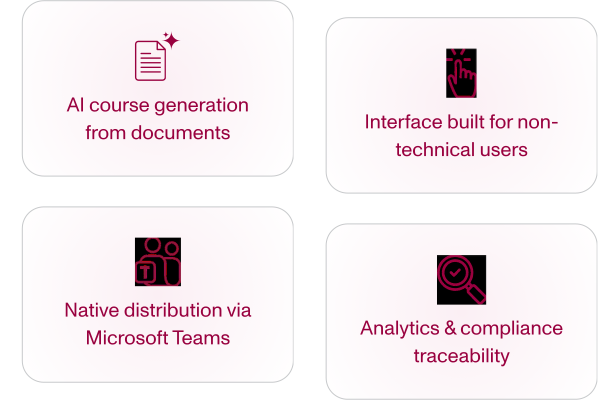
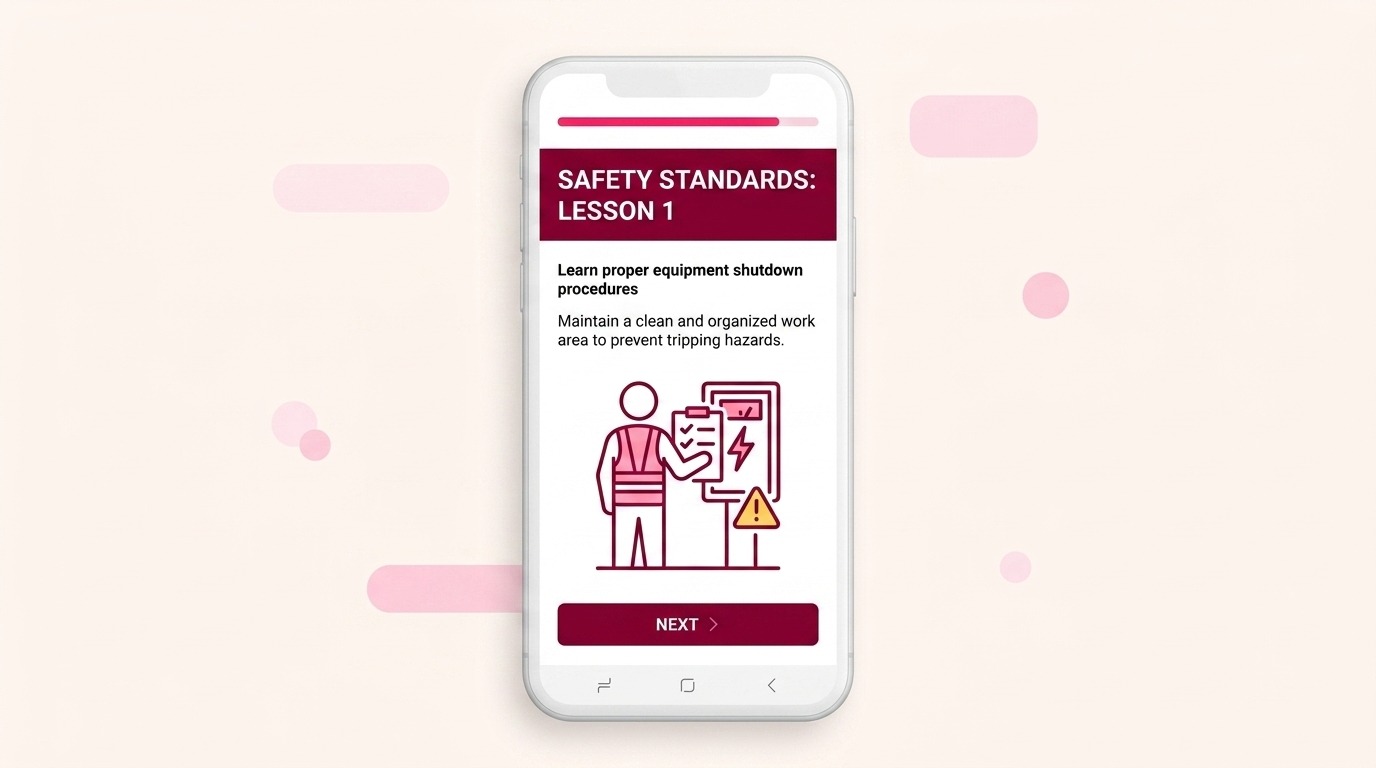
Existing documents, including internal procedures, operational manuals, and regulatory directives, are uploaded directly to the platform. The AI analyses the content and generates a structured course in minutes, with micro-lessons, verification quizzes, explanatory images, and synthetic voiceover. No e-learning skills required from the person creating the course.
The shift is operational, not just technological.
The people who know the safety procedures can now create the training on those procedures directly, without going through anyone else. Anyone on the HSE team can create, edit, and publish a course independently, with no IT involvement. When a regulation changes, the team updates the course on their own, with no new negotiations, quotes, or waiting.
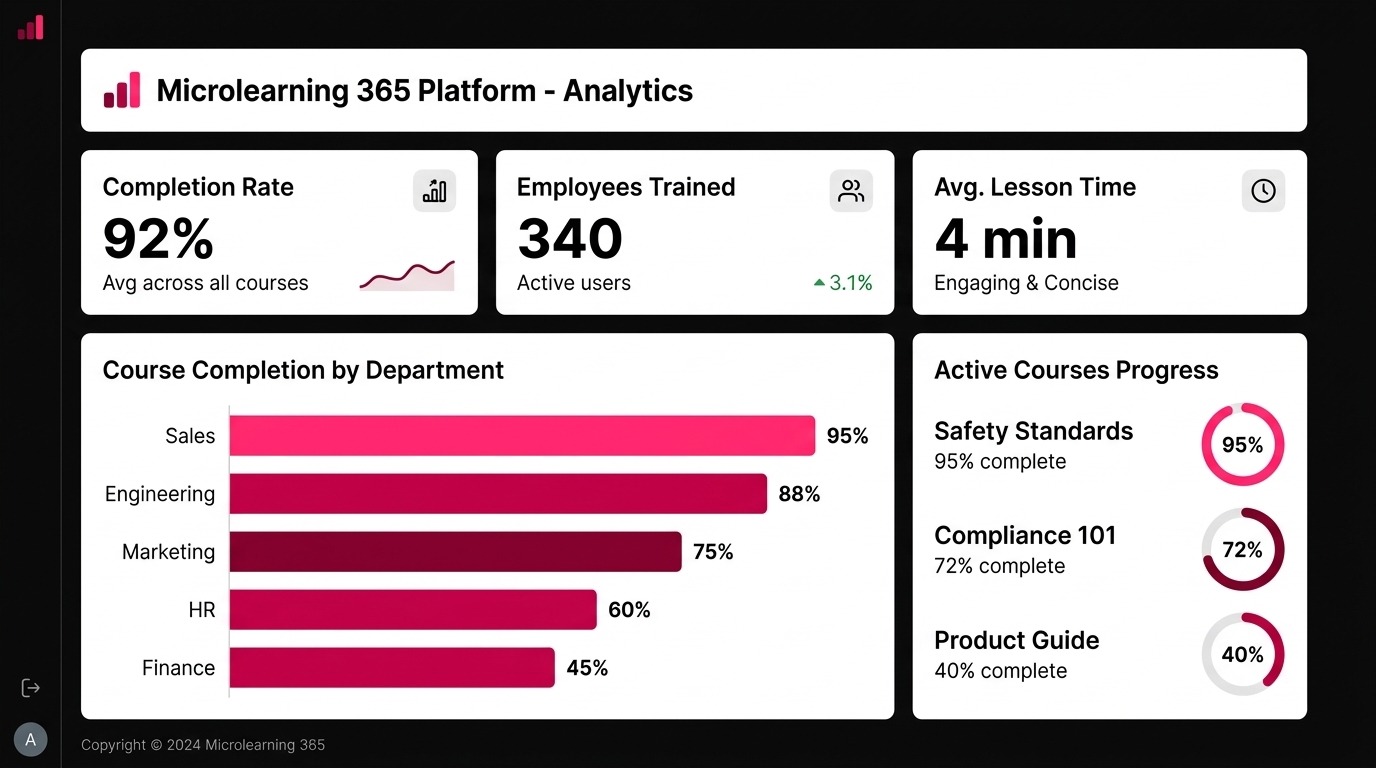
Courses are distributed via Teams, reaching employees in the environment they already use for internal communications, with no new apps or separate portals to log into. Completion rates, time spent on each course, and quiz attempt counts are trackable per course and per user, providing a documented basis for regulatory compliance at every level.
The practical result is a team that no longer depends on external timelines to keep its training current. The gap between a regulatory update and trained staff has gone from weeks to days.
Results: 53 courses, 386 learners, and weeks turned into days
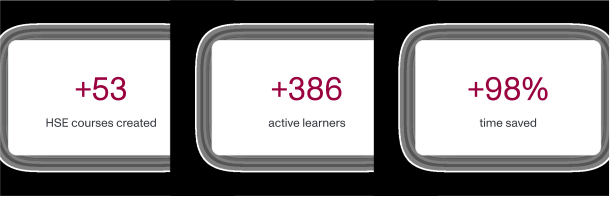
In under a year on the platform, the HSE team published 53 safety training courses, reaching 386 active learners across the organisation. For a team that previously measured its output in courses-per-quarter with external agency involvement, producing 53 courses independently in under twelve months represents a fundamental change in operating capacity.
The platform metrics confirm the approach works not just in theory but in practice:
- Average lesson length: approximately 1 minute. Micro-lessons are compact by design. They fit into the working day without pulling operational staff away from the field for extended periods. A field worker can complete a lesson between tasks, not just during a scheduled training block.
- Average module length: 19 minutes. A complete module is finished in a single session, which means no fragmented learning, no overdue backlogs, and no employees half-trained on a procedure because they ran out of time.
- 1 to 3 attempts on average to pass the final quiz. Employees understand the material, not just complete the course. Passing a quiz on the first or second attempt is one of the strongest indicators of instructional effectiveness. The AI generates quizzes calibrated to the source material, so the questions reflect what was actually taught, not generic knowledge checks that have little connection to the specific procedure at hand.
This client is among the most active users of the platform across the entire Microlearning365 portfolio. The team exchanges feedback with the product team on a regular basis, a pattern that reflects genuine integration into daily operations rather than a tool that got used once and quietly shelved.
The most significant change is the one hardest to capture in a metric: the speed at which the organisation can now respond to a regulatory update. When a new directive arrives, the HSE team no longer has to call a vendor. They open the platform, upload the document, and publish the course. What used to take weeks now takes days.

What's Next?
The HSE team continues to expand its internal course catalogue, adding new courses on emerging safety topics and keeping existing ones current with the latest regulatory updates. Maintaining a live catalogue is itself a new capability.
Before Microlearning365, updating a course meant going back to the agency, reopening the brief, and waiting again. Now it means opening the platform and editing directly.
The platform has stopped being a tool used occasionally and become the standard channel through which safety training is produced and distributed across the organisation.
The next step under evaluation is extending the model to other departments within the organisation that have recurring mandatory training needs. The infrastructure is already in place. The logic is the same: give the people who know the subject the tools to create the training themselves, and the bottleneck disappears.
📌 When the people responsible for safety can also create the training, the time between a regulatory update and staff training drops from weeks to days.
Still have corporate training on your to-do list? Book a demo and discover how Microlearning365 turns your internal documents into professional courses in minutes.


.svg)
.svg)
.svg)