
.svg)
When the people to be trained are truck drivers on the road, the first question is how to get the training to them. An approach that assumes a company workstation, a Microsoft licence, and a free calendar slot excludes the entire target audience before the first course has even been designed.
Most e-learning platforms are built with office employees in mind. The user sits at a desk, logs in with their company account, opens the LMS in a browser, and works through the material. For a workforce that spends its day behind the wheel, none of those assumptions hold.
A different model was needed, and a platform built to support it.
The Problem: no fixed workstations, no Microsoft licences, and a regulatory deadline that cannot move
The client is an Italian company in the transport and logistics industry. When it decided to roll out a training programme for its drivers, the preliminary question was not what content to cover, but how to deliver it to people who do not sit at a desk, do not have a corporate device, and do not have a Microsoft 365 licence.
Two problems needed solving simultaneously, under time pressure.
The first was structural. The truck drivers forming the population to be trained do not have individual Microsoft 365 licences. With a traditional LMS, the standard answer is to purchase a licence for each user. For an operational workforce that may include seasonal staff, contractors, and external drivers, that cost is not just high at launch. It repeats at every training cycle, making the budget unpredictable and the model difficult to sustain long-term.
The second problem was timing. The company had precise windows in which to deliver certain courses, tied to regulations or procedural updates with fixed deadlines. Selecting a traditional enterprise platform, with implementation timelines that routinely stretch to weeks or months, was not compatible with those constraints. Missing a regulatory deadline is not an option in transport and logistics. The training had to be live before the deadline, not after it.

The three challenges compounded:
- No fixed workstation: drivers work on the move, with access to training only via smartphone during breaks between routes. Any solution requiring a desktop browser or a corporate device was ruled out from the start.
- No Microsoft licence: purchasing one for each user would have made the project economically unviable, particularly for a workforce that includes people who may only need access for a single training cycle.
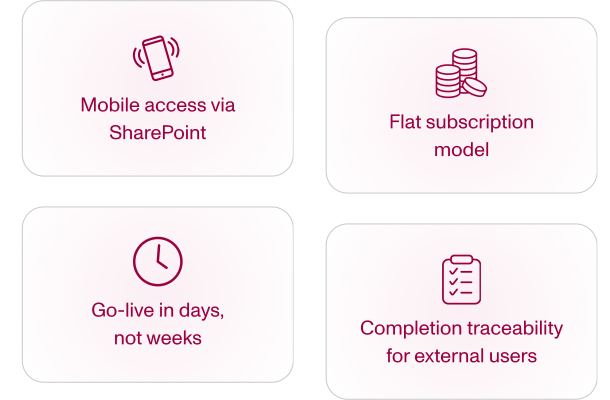
- Tight regulatory deadlines: the go-live timelines of traditional LMS platforms were structurally incompatible with the operational reality. The company needed a solution that could be active in days, not weeks.
Our Solution: SharePoint delivery on mobile, one subscription for everyone, live in days
Microlearning365 resolved both constraints with the same underlying architecture, without requiring the company to build separate infrastructure for its operational workforce.
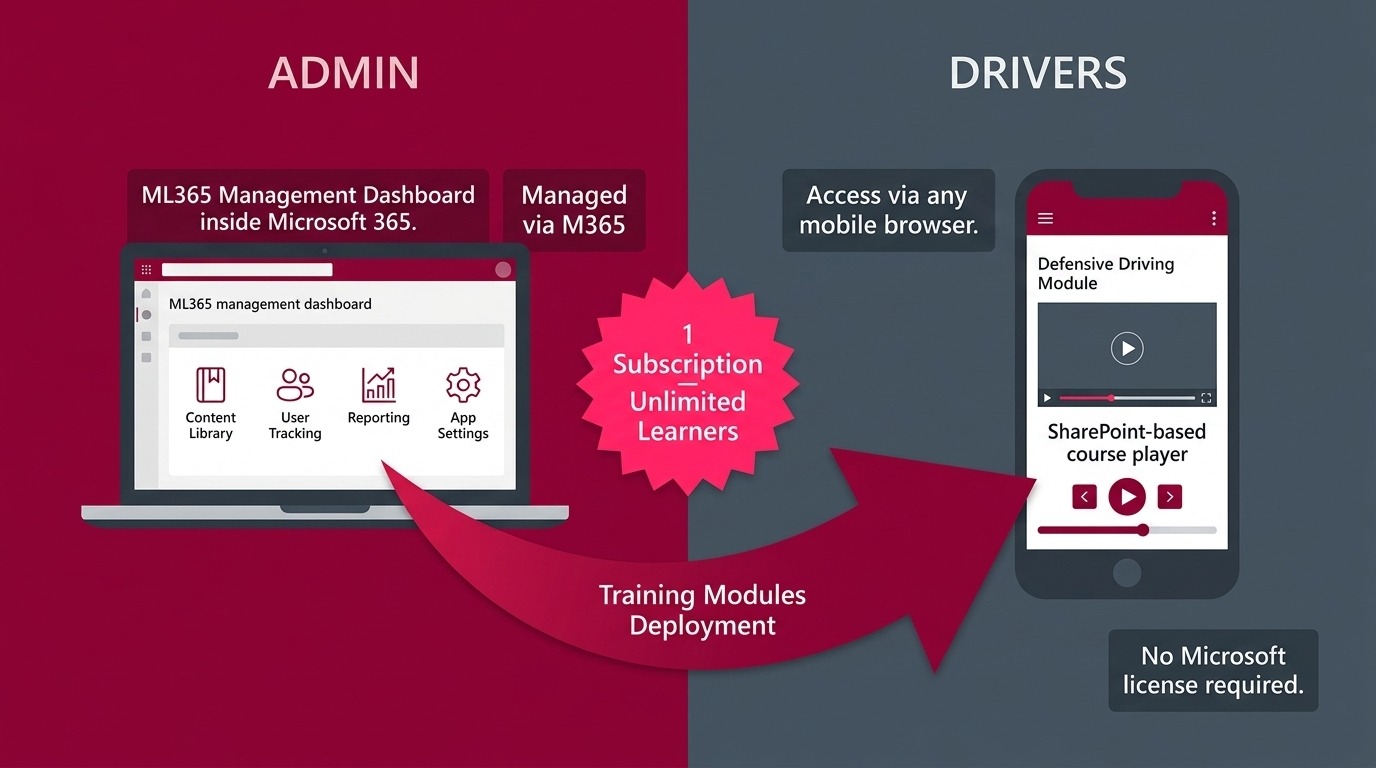
Platform administration lives within the company's existing Microsoft 365 environment, managed by whoever handles the account. Course delivery, however, happens through SharePoint, accessible from any mobile device, with no individual Microsoft 365 licence required for end users.
Drivers open the course on their smartphone during a break, with no dedicated app to install and no separate account to create.
Microlearning365's subscription model does not scale with the number of end users. A single subscription covers training for hundreds of recipients, internal or external, with or without an M365 licence. The cost of training 150 drivers is the same as training 10 office employees, making the economics predictable regardless of workforce size.
On the operational side, setup was completed in days, with no long implementation project and no dedicated IT team required. The company activated the platform, configured the courses, and began delivery within the tight time windows available.
Every completion is recorded and trackable even for users without a corporate account, providing a documented basis for regulatory compliance.
Results: 150 drivers trained on mobile, zero additional licences, rollout in days
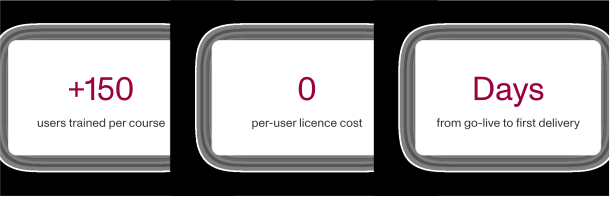
The company now delivers training to a population of approximately 150 users per course, primarily truck drivers who access content on their smartphones during natural breaks in their working day.
That number may seem modest compared to enterprise-scale deployments, but the relevant comparison is not with the size of the audience. It is with the cost and complexity of reaching that audience through any alternative approach.
Before Microlearning365, training this population would have required either purchasing Microsoft 365 licences for each driver, which was economically unviable, or finding a separate platform with its own onboarding process, implementation timeline, and per-user pricing. Neither option worked within the constraints the company was operating under.
The impact of the no-licence model is measurable on two levels:
- Economic: a population of learners that would have been financially out of reach with a traditional LMS is now covered under a fixed, predictable subscription. No additional licences, no per-user fees, no costs that scale with headcount. The 150 drivers trained in the first cycle cost exactly the same per head as the next 150 will. For organisations that manage large operational workforces with variable headcounts, that predictability changes how training programmes get planned and budgeted.
- Operational: the rollout time for mandatory training dropped from weeks to days. For an industry where regulatory compliance has hard deadlines, that compression is not a nice-to-have. It is the difference between meeting the requirement and missing it. The company no longer has to choose between the platform it wants and the timeline it needs.
Beyond the economics, there is a practical dimension worth noting. Drivers are completing training on their smartphones, on their own time, during breaks between routes. That means no disruption to operations, no days off the road for classroom sessions, and no coordination overhead to get a large group of people in the same place at the same time. The training fits around the work, rather than interrupting it.

What's Next?
The current architecture is ready to scale to a larger number of users and courses without structural changes. There is no infrastructure to rebuild, no new licences to negotiate, and no implementation project to restart. The platform that covers 150 drivers today can cover 500 tomorrow under the same subscription terms.
The company is evaluating extending the model to other segments of its operational workforce, applying the same logic to roles that share a similar profile: field workers, external contractors, and operational staff who work away from a fixed office environment. Each of those groups represents a population that traditional LMS platforms struggle to reach cost-effectively.
With the infrastructure already in place, the next step is simply deciding where to apply it.
📌 Being able to deliver training to people without a Microsoft licence, on mobile, completely changed the economics of the project.
Still have corporate training on your to-do list? Book a demo and discover how Microlearning365 turns your internal documents into professional courses in minutes.


.svg)
.svg)
.svg)