

Microlearning is a corporate training approach that breaks content down into short modules, lasting 3-5 minutes, designed to be completed even during a break between two meetings. Unlike traditional courses, which often last an hour or more, microlearning focuses on frequency and concentration, not duration.
In this guide you will see how microlearning works, what scientific research says about memory, how it differs from traditional training, what advantages it brings to a company, what a course looks like in practice, and when it makes sense to adopt it.
What is microlearning?
Microlearning is a training methodology that organizes content into self-contained micro-lessons, each focused on a single learning objective. Each module is completed in a few minutes and can be accessed from any device, including a smartphone.
The principle behind it is not just organizational, but cognitive. Studies on memory, starting with the research of German psychologist Hermann Ebbinghaus conducted as far back as the nineteenth century and replicated many times since, show that without reinforcement a person forgets on average about half of what they have learned within an hour, and an even larger share within 24 hours. This means that a long, isolated training session loses most of its effectiveness by the very next day, unless it is revisited and reinforced over time.
Added to this is a second factor: people's ability to concentrate has progressively declined. Research by Professor Gloria Mark of the University of California, Irvine, conducted over the course of two decades, has shown that the average continuous attention span on a screen dropped from about two and a half minutes in 2004 to about 47 seconds in the most recent measurements.
Microlearning responds to these two phenomena with short, repeated content that is easier to remember and apply at work.
With Microlearning365, it is possible to generate a complete course starting from a company document, such as a policy or a manual, in just a few minutes, thanks to an AI-based engine integrated into Microsoft 365.
How does it differ from traditional training?
Traditional training is based on long sessions, often in a classroom or videoconference, organized around a fixed schedule. Microlearning, by contrast, distributes learning over time and makes it available on demand.
The main differences concern four aspects:
- Content duration: a traditional lesson lasts on average 45-60 minutes, while a microlearning module is completed in 3-5 minutes.
- Production time: building a traditional e-learning course takes on average 2-3 weeks, while an AI-generated course can be ready in a few minutes.
- Delivery format: traditional courses often require a dedicated platform, while microlearning integrates into tools already in use, such as Microsoft Teams.
- Reinforcement logic: traditional training concentrates everything into a single session, while microlearning distributes content across multiple points in time, leveraging spaced repetition that slows down the forgetting curve.
What are the advantages for companies?
The first advantage is speed. A course that with the traditional method takes weeks can go from document to published course in a few minutes.
As for costs, traditional training involves costs for external agencies, translations, and continuous updates. A model based on integrated AI reduces these costs by up to 90% compared to the classic method.
In addition, this approach improves engagement within the company. Notifications on Microsoft Teams are opened much more quickly than corporate emails, which means colleagues complete modules more consistently than with long courses disconnected from the daily flow of work.
Less discussed, but just as concrete, is the advantage of traceability. Every micro-lesson produces measurable data on completion, time spent, and quiz results, allowing HR and L&D to understand precisely where training is working and where additional intervention is needed. The result is a higher completion rate, with a steady increase in active learners on the platform.

How does a microlearning course work in practice?
The operational flow usually follows four steps:
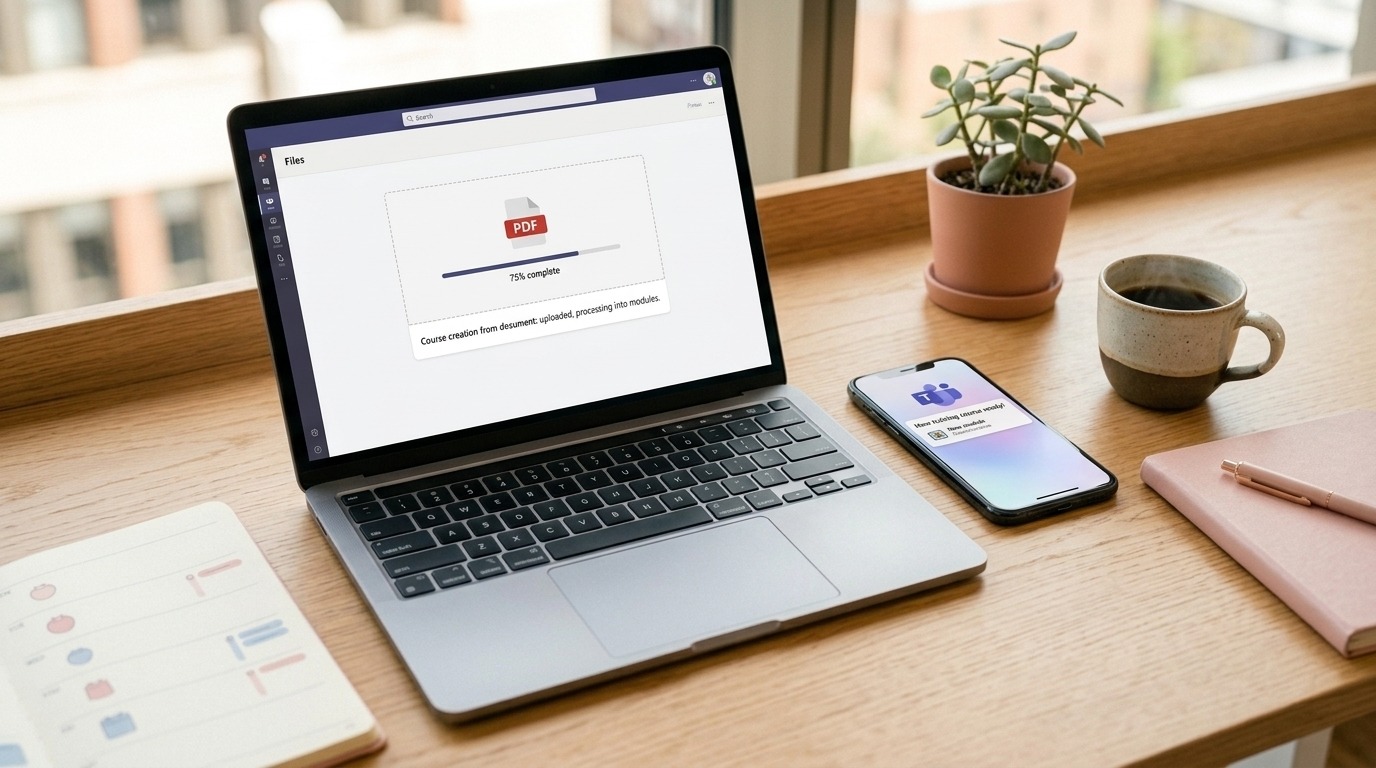
- Document upload: it starts from an existing file, such as an operating manual, internal policy, or safety procedure, in PDF, Word, or PowerPoint format.
- Course generation: an AI engine reworks the content into chapters, micro-lessons, quizzes, and images, maintaining the logical coherence of the original document.
- Contextual translation: the content can be translated into dozens of languages while preserving acronyms and technical terminology.
- Publication: the course is distributed directly on Microsoft Teams or exported in SCORM format for those already using another LMS.
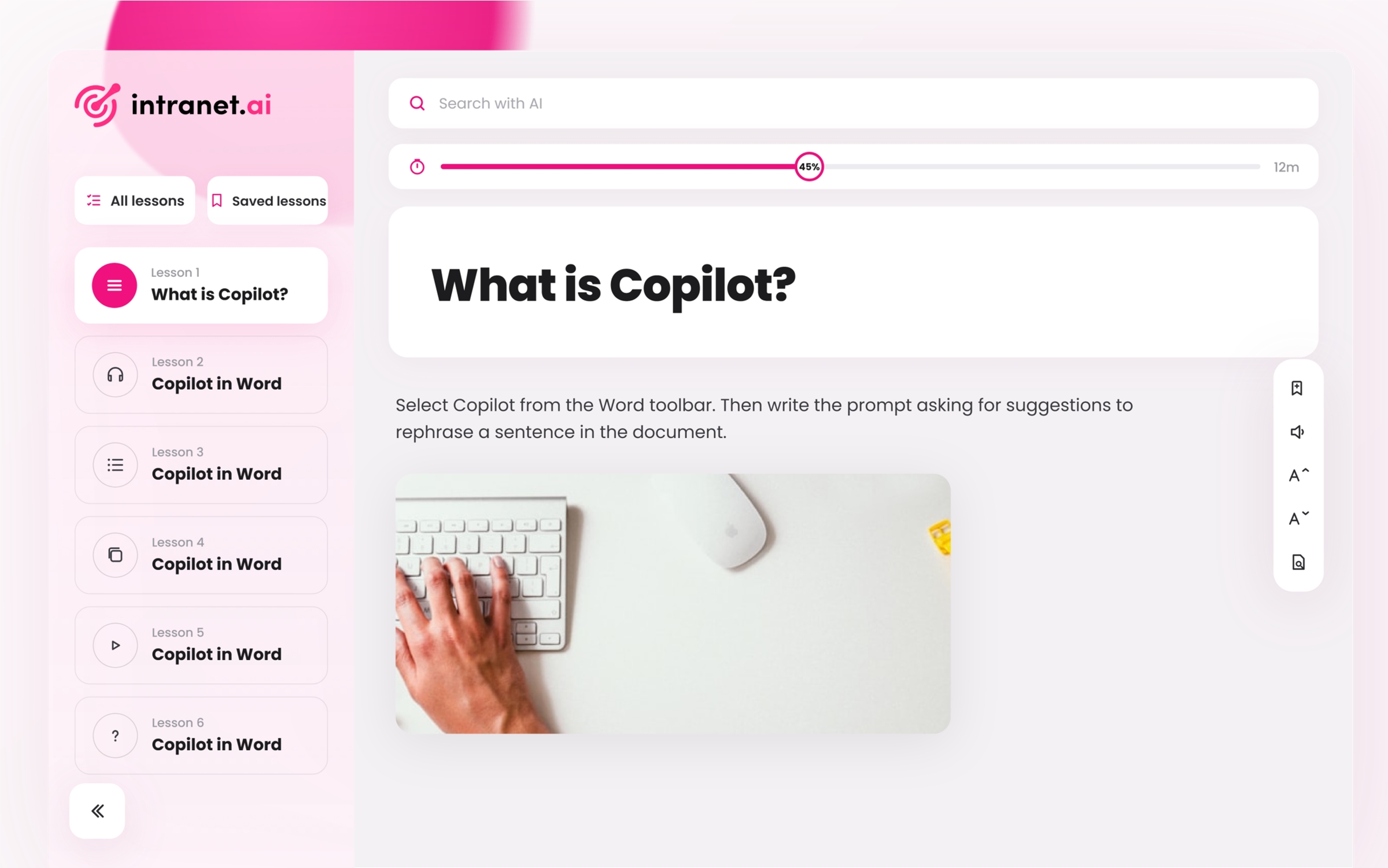
A course generated this way includes different formats, including lessons with AI-generated images, synthetic voiceover in natural-sounding voices, flash cards for quick review, true/false quizzes, fill-in-the-blank exercises, multiple-choice quizzes, and a final test. Alternating between different formats helps maintain attention, in line with what has been observed regarding the decline in continuous concentration.
Many companies use this workflow to produce dozens of safety courses, with a non-technical team able to manage the entire process without external agencies.
But microlearning is also effective in other contexts. It can be used for onboarding new hires, mandatory and regulatory training, or ongoing updates on procedures that change frequently.
It does not replace in-depth technical training, which requires longer sessions and guided practice. In that case, microlearning works well as a complement, reinforcing over time concepts already learned in a more structured course.
Microlearning365: corporate training that actually works
Corporate training should take minutes, not months. And it should live where colleagues already work, not on yet another platform that no one will ever open.
With Microlearning365 you upload a company document, a procedure, a policy, a manual, and within minutes you have a complete course, with lessons, quizzes, images, and voiceover, ready to distribute directly on Microsoft Teams. No waiting and no inflated budgets.
The catalogue includes more than 300 ready-made courses on onboarding, compliance, safety, and much more, all translatable into over 40 languages with a single click. And if you prefer to delegate everything, the Done-For-You plan takes care of every aspect of training on your behalf.
The result?
All colleagues in the company actually complete the courses, because they are easier to find and interesting to follow, they finish them in a few minutes, and they receive reminders on Teams instead of emails that end up being ignored.
FAQ
Does microlearning completely replace traditional training?
No. Microlearning is effective for procedural, regulatory, and onboarding content, while complex technical training still benefits from longer sessions. The two approaches complement each other.
How long does it take to create a microlearning course?
With an AI-based system like Microlearning365, a course can be generated from an existing document in a few minutes, compared to the weeks required by the traditional method.
Does microlearning also work for employees without a company computer?
Yes, if the platform supports mobile access and SharePoint integration, it is possible to deliver training even to operational staff without an individual Microsoft 365 licence.
Which metrics indicate whether a microlearning program is working?
The main metrics are module completion rate, average completion time, and quiz results. A good program shows a consistent completion rate over time, not just in the first few days after launch.
Why are long training sessions forgotten so quickly?
According to research on Ebbinghaus's forgetting curve, without reinforcement people forget most of what they have learned within the first 24 hours. Distributing content into short modules repeated over time directly counteracts this phenomenon.


Book a free demo
See how Microlearning365 turns your documents into professional courses in minutes.

.svg)