
.svg)
An AI LMS is a learning management system that uses artificial intelligence to automatically generate, translate, and structure training content. In practice, this means turning an existing company document into a complete course with chapters, quizzes, and voiceover in a few minutes, without involving external agencies and without specific instructional design skills.
This article explains what an AI LMS actually does, what it doesn't do, how it handles complex documents, how the risk of hallucinations is addressed, how path personalization and conversational search work, and when it makes sense to use it instead of a traditional training agency.
What is an AI LMS?
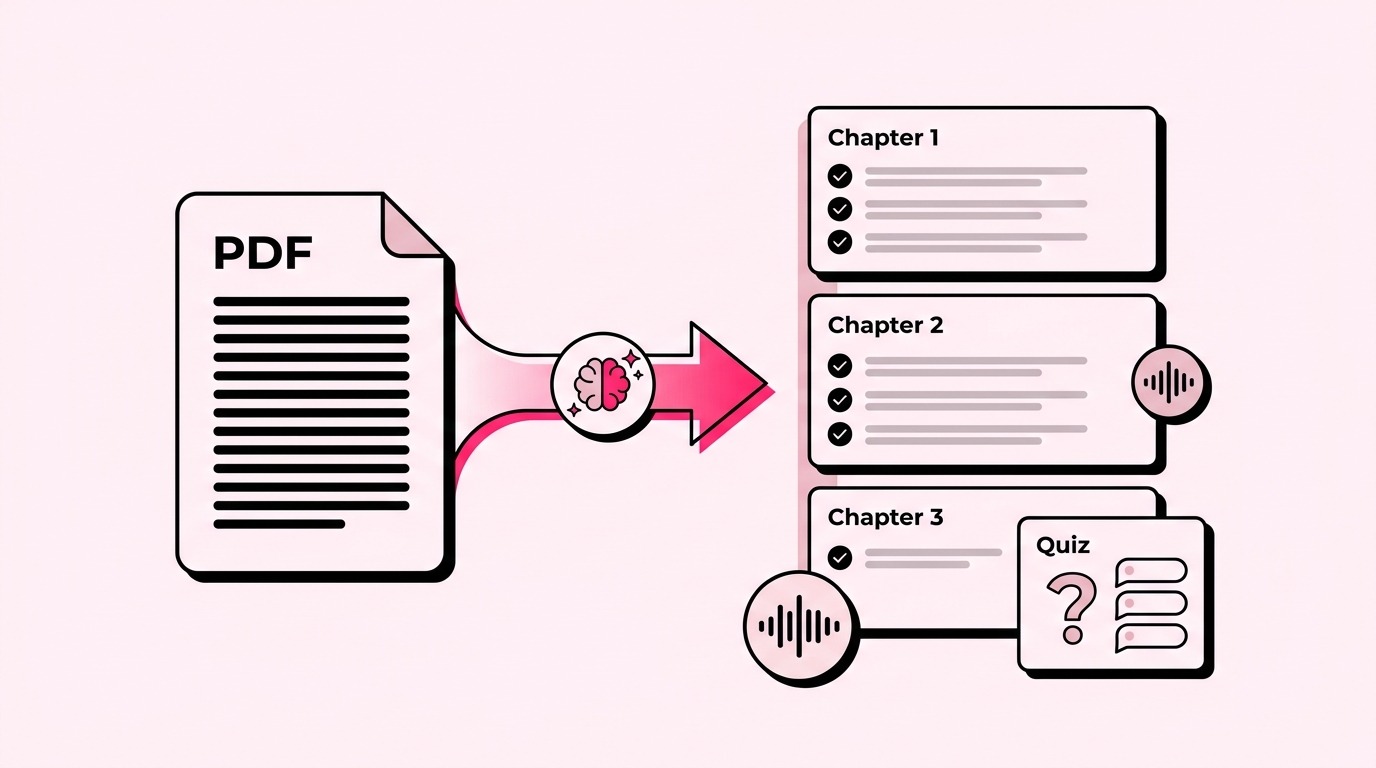
An AI LMS combines the hosting and tracking functions of a traditional LMS with an AI engine capable of generating training content directly from source material. Instead of starting from an empty template, the learning designer uploads a document and the system produces a structured course.
The distinction matters because not every platform that mentions AI actually generates content. Some use AI only for recommendations or search, while content is still built manually. A true AI LMS handles the authoring phase independently, and this distinction should be one of the first questions asked when evaluating a vendor.
How an AI LMS works
AI in this context performs four main tasks:
- it restructures a document into chapters and micro-lessons,
- generates quizzes and multimedia content consistent with the source material,
- translates the course contextually into other languages,
- lets users ask natural-language questions about the course content.
It doesn't replace judgment about what should be taught, and it doesn't guarantee accuracy on sensitive regulatory topics without human review. A learning designer should still review courses on complex compliance topics before publication, but a well-designed AI LMS dramatically supports and accelerates production.
This doesn't mean, however, that AI authoring only works well with well-structured documents that have clear headings, bullet points, and orderly paragraphs.
In reality, the most advanced systems are able to extract useful content even from more difficult materials: scans of technical manuals, PowerPoint presentations built in a non-linear way, documents with tables dense with regulatory data.

The difference between a basic AI system and a more sophisticated one shows up right here.
A basic system treats the document as a block of text and mechanically splits it into sections of similar length. An advanced system interprets the document's semantic structure, recognizes that a table with regulatory thresholds needs to be treated differently than a descriptive paragraph, and builds coherent lessons from both.
For companies working with complex technical documentation, such as chemical safety data sheets, maintenance procedures with diagrams, or industry regulations with cross-references, this ability to interpret the document's structure matters far more than generation speed itself.
A document is uploaded in PDF, Word, or PowerPoint format, and the AI analyzes its structure, divides it into logical sections, and builds a sequence of short lessons, each with a clear learning objective, supporting images, and a quiz. With Microlearning365, the entire process takes a few minutes, compared to the 2-3 weeks typically required in a traditional workflow.
An AI LMS that genuinely structures content organizes information into short, distinct units, instead of simply reformatting the same text into a different format.
Path personalization: AI beyond course generation
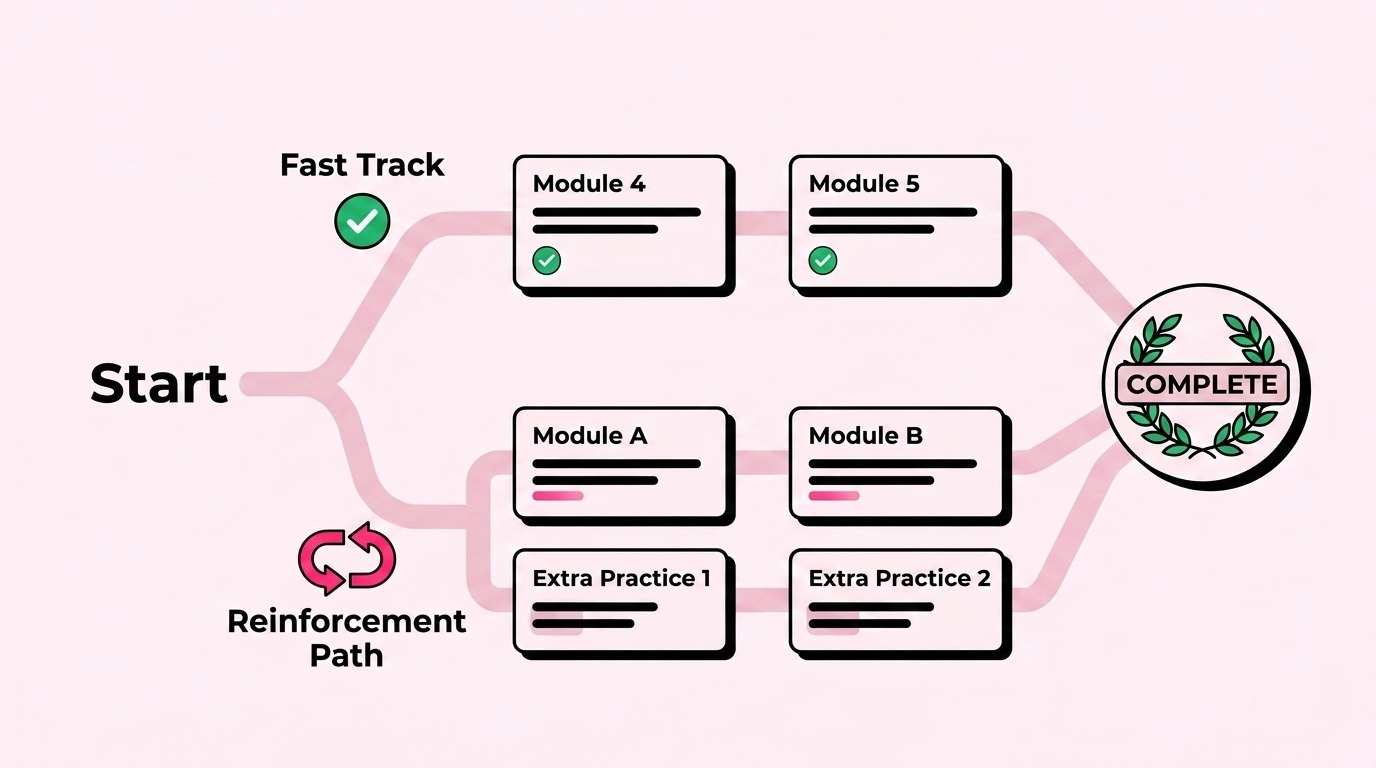
Generating a course is only the first application of AI in an LMS. A more recent frontier, still not widespread among platforms on the market, is dynamic personalization of the training path based on individual user behavior.
The principle is simple: if a user completes a lesson in half the average time and passes the quiz on the first attempt, they probably already know the topic. If instead they take twice as long and don't pass the quiz within the expected number of attempts, that module needs reinforcement.
An AI system capable of reading these signals in real time can adapt the proposed path, suggesting a review or skipping content already mastered.
It's worth asking vendors explicitly during the evaluation phase: does the system adapt the path based on individual results, or does it deliver the same content to all users regardless of their starting level?
The risk of hallucinations: how it's managed in training authoring
Anyone working with generative AI tools is familiar with the phenomenon of hallucinations. This refers to the phenomenon where the model produces content that sounds plausible but is not correct, inventing details, figures, or regulatory references that don't exist in the source document.
In the context of training authoring, this risk has concrete implications. A course on a safety procedure that contains incorrect information isn't just an instructional quality problem, because in regulated industries it can have operational and legal consequences.
The solution isn't to give up on AI, but to understand how a well-designed system manages it.
A reliable AI LMS generates content based exclusively on the source document provided, without adding unverified external information. This approach, technically called retrieval-augmented generation (RAG), drastically reduces the risk of hallucinations because the model is constrained to cite only what is present in the original document.
Human review before publication still remains the most important safeguard, particularly for content involving safety, regulatory matters, or any area where an inaccuracy can have practical consequences.
RAG also enables conversational search within a course. Users can ask natural-language questions and receive answers based directly on the source document, with the relevant excerpt cited. This is particularly useful for complex technical or regulatory content, where employees often need to quickly verify a specific detail during actual work, without having to review an entire lesson.

AI LMS vs training agency: which one should you choose?
The question many HR managers ask themselves when evaluating an AI LMS is: does this replace the training agency we already use, or does it work alongside it?
The answer depends on the type of content and the objectives.
A training agency adds value especially when a course requires original pedagogical design, complex interactive scenarios, professionally produced video, or content that doesn't yet exist in any company document. In these cases, the starting point isn't a document to convert, but a training need to translate into content from scratch.
An AI LMS, by contrast, excels when the content already exists, in the form of manuals, policies, procedures, technical data sheets, or internal notes, and the problem is making it usable quickly, in a way that's updatable and scalable.
For most companies, a hybrid model works well: the AI LMS handles routine production, the kind involving procedures, compliance, and frequent updates, while the agency steps in for strategic courses that require more elaborate design.
How to prepare to introduce an AI LMS at your company in 3 steps
Adopting an AI LMS doesn't require a months-long implementation project, but it does involve a few preliminary choices that significantly affect the effectiveness of the launch. Here are the three main steps to follow:
- Take inventory of company documents: operating manuals, internal policies, quality procedures, onboarding guides, safety data sheets. In most companies this material already exists but has never been turned into training, simply because the traditional production process was too long and expensive to justify it. You need to gather all the documents that could become courses.
- Identify priority audiences: who needs structured training most urgently? New hires? Teams with procedures subject to frequent updates? The department that needs to demonstrate compliance ahead of an audit? Starting with a specific audience with a clear need produces measurable results faster than a generic company-wide launch.
- Decide how to measure success before launch: completion rate, quiz results, reduction in onboarding time, savings on production costs. Choosing two or three metrics in advance allows you to evaluate impact objectively and bring concrete data when reporting on the investment to leadership.
So, an AI LMS doesn't require redesigning the L&D team's workflow from scratch. Company documents that already existed become the starting point for course generation, instead of requiring a briefing with an external agency. The L&D team can focus on what genuinely requires human expertise, such as defining training objectives, interpreting completion data, and intervening where training isn't producing the expected results.

FAQ
What makes a platform an AI LMS and not just an LMS with AI features?
A true AI LMS generates the training content itself, restructuring documents into courses, instead of using AI only for search or recommendations while content creation remains manual.
How is the risk of errors or inaccuracies in AI-generated courses managed?
A reliable AI LMS generates content based exclusively on the source document, reducing the risk of invented information. Human review before publication remains the most important safeguard, particularly for regulatory or safety content.
Can an AI LMS adapt the training path to the individual user?
The most advanced systems read behavioral signals, such as time taken and quiz results, and adapt the path accordingly. It's worth checking this feature explicitly during vendor evaluation.
When does it make sense to use an AI LMS instead of a training agency?
When the content already exists in the form of company documents and the problem is making it usable quickly. The agency adds value especially for content that doesn't yet exist and requires original pedagogical design.
How does conversational search within a course work?
It uses retrieval-augmented generation (RAG) to allow natural-language questions with answers based on the source document, with the relevant excerpt cited. Available on Microlearning365's Premium plan.
Does an AI LMS eliminate the need for an instructional designer?
No. It removes most of the manual production work, but defining objectives, reviewing accuracy, and interpreting completion data still benefit from instructional design expertise.


Book a free demo
See how Microlearning365 turns your documents into professional courses in minutes.


.svg)