
.svg)
Artificial intelligence applied to corporate training generates complete courses from existing documents, translates them into multiple languages while preserving technical terminology, and creates automatic quizzes to verify learning. It does not replace human judgment on content quality, but it eliminates most of the manual work that today takes weeks.
In this article we will look at what AI concretely does in a modern training system, which tasks it truly automates, how this connects to the way people retain information, and which aspects remain under the control of the L&D team.
What does AI do in corporate training?
Artificial intelligence, in the context of corporate training, mainly performs four functions:
- it reworks existing documents into structured courses,
- translates content into other languages,
- generates quizzes and assessment materials,
- allows users to query the course content with natural-language questions.
It's important to distinguish this approach from simple automatic conversion. A good AI system does not just turn a PDF into slides, but applies reasoning to the structure of the content, identifies key concepts, and organizes them into micro-lessons with a clear learning objective for each one. Many tools that describe themselves as "AI-based" use artificial intelligence only for secondary functions, while content production remains entirely manual.
Let's look at the four functions in more detail.
Automatic course generation from documents
The most direct use case is turning a company document (an operating manual or internal policy) into a structured course. The system analyzes the text, divides it into chapters and micro-lessons, generates supporting images, and proposes assessment questions consistent with the content.
With Microlearning365, this step takes a few minutes, compared to the typical 2-3 weeks of a traditional instructional design process. A further advantage is the ability to update the course immediately when the source document changes, without having to repeat the entire production process.
This has a concrete impact on the daily life of L&D teams. Instead of starting a project with an external agency every time a procedure is updated, the training manager can edit the source document and regenerate the course independently, without specific technical skills and without waiting weeks.

Translation and multilingual adaptation
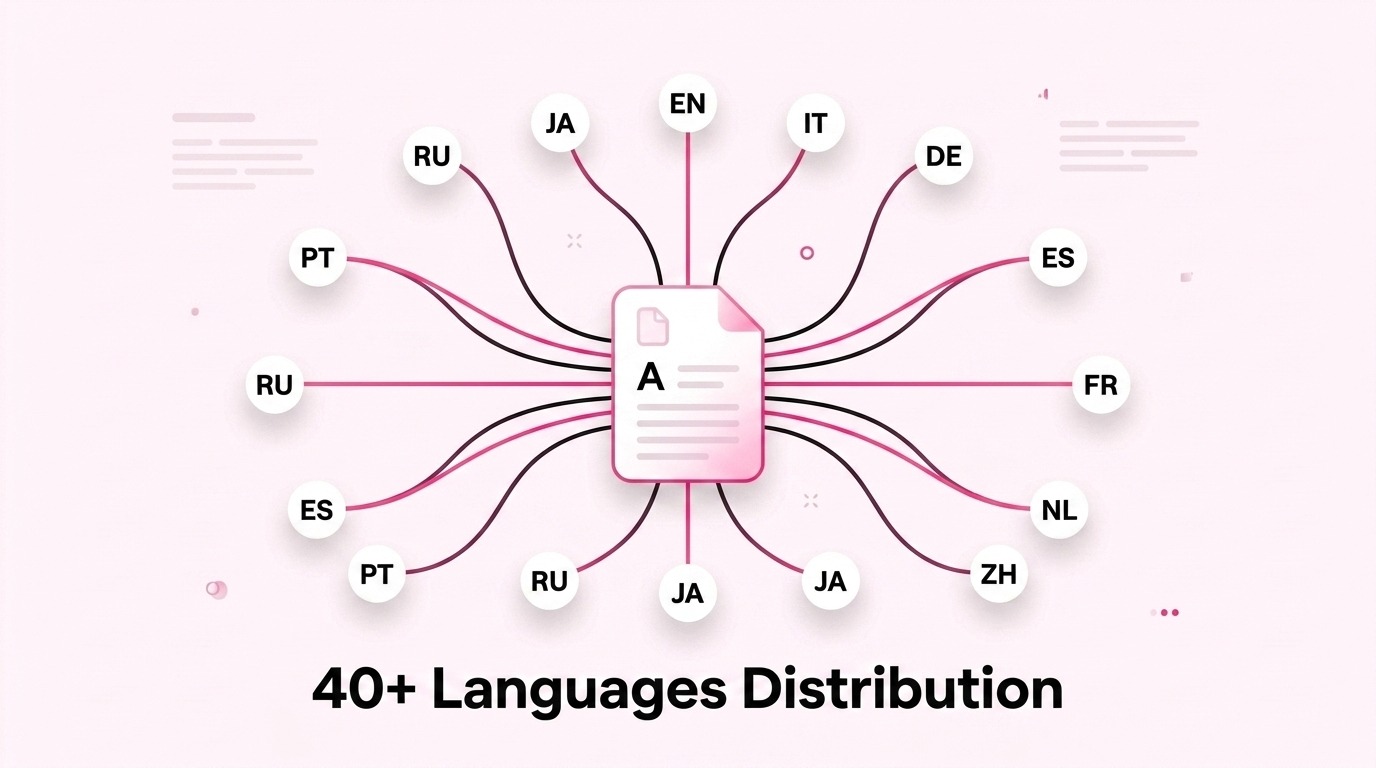
A second area where AI offers a concrete advantage is translation. The most advanced systems preserve acronyms and technical terminology, and also adapt quizzes and voiceover audio to the target language.
For a company with teams in multiple countries, this means being able to distribute the same course in more than 40 languages without having to manage an external vendor for every translation, and without the additional cost estimated at between 800 and 1,000 euros per language under the traditional model. Contextual translation is also qualitatively different from basic machine translation, because it consistently preserves the tone of the original document and maintains terminological consistency across the different versions of the course.
Automatic quizzes and assessment
AI automatically generates quizzes consistent with the course content, in different formats, from true/false to multiple choice, to fill-in-the-blank exercises and a final test. This allows companies to verify learning without having to manually write every question.
Quizzes generated directly from the lesson content tend to be more consistent with what was actually taught. Distributing a small quiz at the end of each micro-lesson, instead of a single final test, reinforces short-term retention, leveraging the same spaced repetition principle that reduces the effect of forgetting.
Quiz results also produce useful data, since they can be used to identify which sections are understood less well and where content should be revised.

Conversational search: AI inside the course
A less well-known but important function is conversational search within the course. The user can ask natural-language questions and receive answers based on the source document, with citations to the relevant excerpts.
This is particularly useful for complex technical or regulatory content, where colleagues often need to check a specific detail during their daily work, without having to review an entire lesson. Instead of scrolling through the pages of a manual, the user can ask a direct question and receive a precise answer, anchored to the official document.
This functionality is based on a RAG (Retrieval-Augmented Generation) architecture, the same technology used to build AI agents capable of answering questions about large document archives, applied specifically to the training context.

How to evaluate an AI system for training
When evaluating an AI tool for corporate training, it is worth checking a few specific aspects.
The first is whether the system actually generates structured content or simply reformats the original text. Another aspect is translation quality: a contextual translation that preserves technical terminology is significantly different from a literal translation.
The third point to consider is the update model. How easily can a course be modified when the source document changes, without having to start over from scratch? Finally, it is important to make sure the platform produces verifiable data for each user, essential for companies subject to audit requirements or regulatory compliance.
But what doesn't AI replace?
The choice of how to structure a long-term training path, which topics to address in which order, and how to measure the impact on employees' actual behavior, is a decision that requires human expertise and knowledge of the organizational context. Likewise, defining training objectives, deciding what to include in an onboarding path, and evaluating the overall quality of a course still require the judgment of a professional.
AI, therefore, does not eliminate the responsibility of verifying the accuracy of content, particularly when it concerns safety, regulatory compliance, or critical procedures, nor does it replace the human strategic perspective, but it certainly represents an innovative advantage for companies that want to improve not just the speed but above all the effectiveness of their internal training procedures.

FAQ
What types of documents can be turned into a course?
Technical manuals, company policies, operating procedures, compliance guides, and raw notes in PDF, Word, or PowerPoint format. The system reworks the content while maintaining the logical coherence of the original document.
How does automatic course translation work?
The system translates content contextually, preserving acronyms and technical terminology, and also adapts quizzes and voiceover audio to the target language, without requiring an external vendor for each language.
What is conversational search within a course?
It's a feature that lets the user ask natural-language questions while taking the course, receiving answers based on the source document with citations to the relevant excerpts. It is available on the Premium plan.
Why aren't all AI training platforms equivalent?
Some use AI only for secondary functions like search or suggestions, while content production remains manual. A true AI system handles the authoring phase independently, structuring content into micro-lessons with clear learning objectives.
Can artificial intelligence create a course with no human involvement at all?
It can generate the complete structure of the course, but human review remains important, especially for complex regulatory or technical content. The value of AI is drastically reducing production time, not eliminating L&D team oversight.


Book a free demo
See how Microlearning365 turns your documents into professional courses in minutes.


.svg)