
.svg)
A new hire's first weeks decide far more than how quickly they learn where the coffee machine is. Most companies still treat onboarding as a single event, a welcome pack, an orientation morning, a tour of the office, on the assumption that the rest will sort itself out through osmosis. What actually happens is that managers end up repeating the same explanations to every new joiner, colleagues get pulled away from their own work to answer basic questions, and new hires spend their first weeks piecing together an understanding of how the company really works from whatever they happen to ask about.
A structured onboarding process fixes this by treating the first months of employment as a designed journey rather than a single event: a defined sequence of what a new hire needs to know, when they need to know it, and how that knowledge actually reaches them in a form they will use rather than file away. This guide sets out what that structure should contain, how to sequence it over the first weeks and months, and how to turn material a company already has, policies, process guides, tool documentation, into something a new hire engages with rather than skims once and forgets.
Why a single orientation day is not an onboarding process
The gap between an orientation day and an onboarding process is easy to underestimate, because both produce the same photograph: a new hire sitting through a welcome session on their first morning. The difference shows up afterward. An orientation day answers a handful of questions once, on a day when a new hire is absorbing far more than they can retain, and then leaves everything else to be picked up informally over the following weeks. An onboarding process instead treats that first morning as one stop on a longer route, with the rest of the journey planned out rather than left to chance.
The cost of leaving it to chance lands on people who are not the new hire. Managers become the default source of answers to questions that a well-designed process would have already covered, which means the same explanation gets repeated, slightly differently, to every person who joins the team. Colleagues absorb a steady trickle of interruptions from someone trying to figure out which system does what or who owns which decision. None of this shows up on a budget line, but it is real time, taken repeatedly from people who were not supposed to be running onboarding as a side project.
It helps to separate two things that get bundled together under the word onboarding.
One is administrative: setting up equipment, provisioning system access, completing paperwork, assigning a desk or a badge. The other is informational: helping someone understand how the company is structured, how its tools and processes actually work, what its policies require, and what their own role expects of them day to day. The administrative side is usually handled reasonably well, because it has clear owners and a defined checklist. The informational side is where structure tends to break down, because it depends on whoever happens to be nearby when a question comes up, and that is the side this guide is mainly concerned with.

Structuring the journey from before day one through the first few months
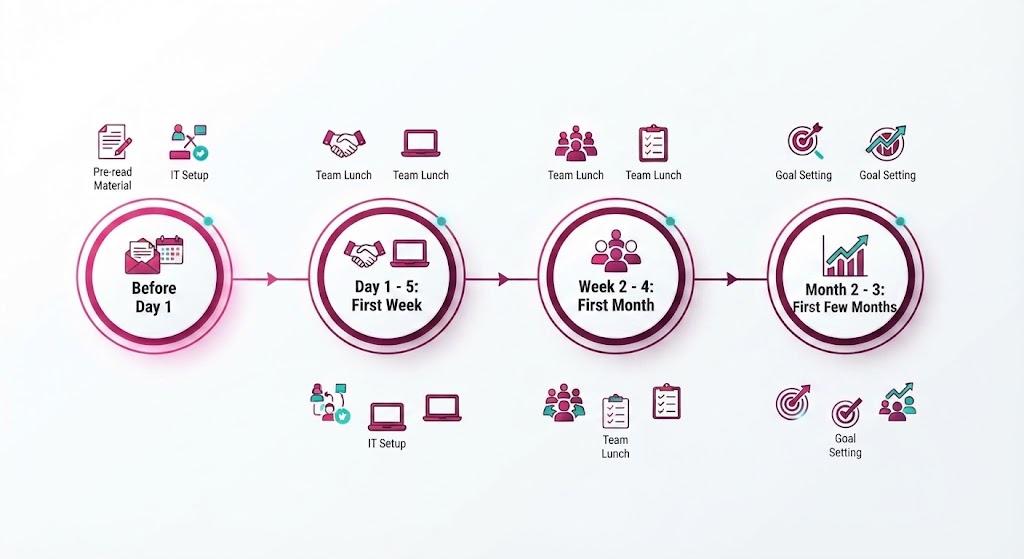
Before the first day
A surprising amount of a good onboarding process happens before the new hire has technically started. Waiting until day one to explain the basics, what the company does, how the team is organised, what the first week will look like, guarantees that day one becomes a bottleneck where all of that has to be delivered at once, competing with equipment setup, introductions, and the general disorientation of a new environment. Sharing a first layer of orientation material in advance, even something as simple as an overview of the company, the team, and what to expect in the opening days, gives a new hire something to arrive with rather than something to receive cold.
This stage is also where expectations get set, which matters more than it sounds. A new hire who knows roughly what their first two weeks will contain, who they will meet, what they will be expected to have learned by a certain point, arrives with much less anxiety than one who has no idea what is coming. That advance visibility costs almost nothing to produce once it exists, but it has to be prepared deliberately rather than assembled the morning someone starts, which is usually when there is the least time to do it well.
The first weeks and months
Day one itself deserves a narrower brief than most companies give it. Between setting up equipment, meeting the team, and finding out where everything is, a new hire's capacity to absorb anything beyond the immediate and practical is limited, so the goal for that single day should be orientation in the literal sense: knowing where things are, who to ask for what, and what the first week actually holds. Loading day one with policy detail, tool training, or role-specific procedure competes with all of that for attention it does not have, and the material rarely survives the day intact. A short, clearly sequenced first-day agenda, covering logistics, introductions, and a preview of what is coming, does more for retention than a longer one that tries to get ahead of the schedule.
The first two to four weeks are where the bulk of company-wide and team-specific material belongs, but the sequencing within that window matters as much as the total amount covered. The instinct in many companies is to front-load everything into this early stretch on the theory that it is better to get it over with, which tends to produce the opposite of the intended effect: a new hire handed the entire company handbook, the full tool stack, and every policy document within the first few days typically retains very little of it, because there was no time between one topic and the next to actually absorb anything. Material that applies regardless of role, how the company is structured, which tools are used company-wide, where core policies live, should come first, because it gives a new hire a map to place everything else on. Team-specific context, how the immediate group operates, which meetings matter, who owns which decision, follows naturally once that map exists, and spacing all of it across several weeks rather than compressing it into the first few days leaves room for each piece to actually land before the next one arrives.
By the second and third month, the content shifts toward what is specific to the role itself: deeper procedural detail, compliance requirements that were flagged early but not fully covered, the judgment calls that only make sense once someone has enough context to hang them on. This is also the stage where a proper check-in earns its place, not as a performance review but as a moment to confirm which parts of the earlier material still need reinforcing before they fade from disuse. Companies that stop tracking onboarding progress once the first week ends tend to lose visibility into this stage entirely, discovering gaps only when a mistake traces back to something that was technically covered in week one and never revisited since.
What new hires actually need to learn, and why a handbook rarely delivers it
Strip away the administrative side and the content a new hire needs to absorb usually falls into a handful of categories: how the company is structured and what it actually does day to day, the tools and systems they will use, the policies and procedures that apply to their role, and anything role-specific they need to perform competently, from a sales process to a safety procedure. Almost every company already has this content written down somewhere, in a handbook, a set of policy documents, a collection of process guides scattered across an intranet or a shared drive.
The trouble is that having the content written down is not the same as having it learned.
A fifty-page handbook handed to someone on their first day gets skimmed at best, and referred back to rarely, because nothing about a long static document invites anyone to actually work through it in order. New hires default to asking a colleague instead, which is faster in the moment but means the answer they get depends on who happened to be free, how well that colleague remembers the current version of the policy, and whether the explanation matches what is actually written down anywhere. Multiply that across every new hire a company brings on, and the result is a slowly drifting, inconsistent version of how things are supposed to work, held together by word of mouth rather than by the document that was meant to define it.
The same static documents also age faster than anyone plans for. A tool gets replaced, a policy gets revised, a process changes after a reorganisation, and the handbook update sits on someone's to-do list for months because rewriting and reformatting a long document is its own project. In the meantime, every new hire who joins during that gap is being onboarded on information that is quietly out of date, through no fault of the document's original author.
Turning onboarding content into a structured, digital learning path
The content problem described above is really a delivery problem: the information exists, but the format it lives in works against being learned, sequenced, or kept current.
Breaking that same content into short, focused modules, one on the company's structure, one on a specific tool, one on a policy area, delivered in a planned order over someone's first weeks rather than handed over all at once, addresses the sequencing question directly. Each module is short enough to complete between other tasks on a busy first day, and a brief check at the end of it, a handful of questions confirming the key points landed, gives a manager visibility into what was actually absorbed rather than a guess based on who attended a session.
That structure also solves the consistency and currency problems in the same move. Every new hire who works through the same modules receives exactly the same information, rather than a version filtered through whichever colleague happened to answer their question, which matters even more when part of onboarding covers something a company needs to be able to prove happened, a safety procedure, a compliance policy, a data handling rule. And because each module is tied to a specific source document rather than baked into a slide deck nobody remembers building, updating the underlying policy and refreshing the module that covers it is a far smaller task than rewriting a handbook chapter and redistributing it to everyone who might read it.
This is also where the traditional objection, that building a proper digital onboarding path takes an instructional designer, a production budget, and months of lead time, has largely stopped being true. Modern AI-assisted authoring tools can take the documents a company already has and turn them into structured modules without requiring in-house e-learning expertise, which puts a properly sequenced onboarding path within reach of an HR team that has neither the time nor the specialist skill to build one from scratch. For a company with more than one office or more than one language in use, the same structure extends naturally: translating an existing set of modules is a considerably smaller undertaking than commissioning new training material or scheduling parallel sessions for every language a workforce speaks.
Which Onboarding Modules to Build First
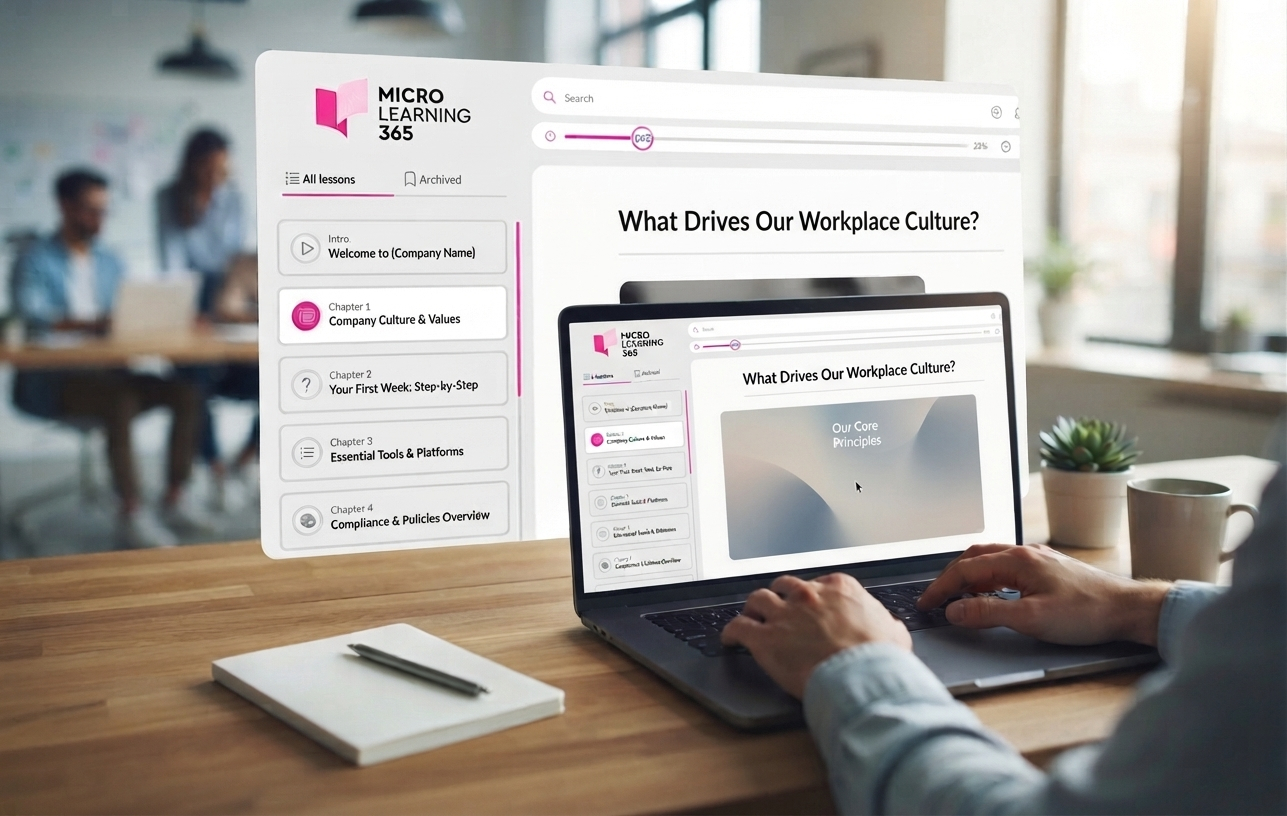
Once the sequencing is settled, the practical question is which modules to actually build first. Six categories cover most of what a new hire needs across the first few months, though the exact list should be adapted to the company's own structure, industry, and regulatory obligations:
- Company and team orientation: an overview of the company's structure, its main functions, and where a new hire's own team fits within it, aimed at answering the questions that would otherwise take weeks of informal conversation to piece together.
- Tools and systems walkthrough: a practical introduction to the core platforms a new hire will use daily, communication tools, file storage, whatever runs the business's main workflow, focused on what to click and where to find things rather than a full feature tour.
- Company policies and code of conduct: the policies that apply to everyone regardless of role, conduct expectations, data handling, time off, expense procedures, presented in a form someone can search back through later rather than reread from page one.
- Role-specific procedures: the processes, tools, or safety and compliance steps tied to a particular function, built separately for each department rather than folded into a single generic module that fits no one well.
- Communication and ways of working: the informal rules that rarely get written down, which channel to use for what, how meetings are run, how decisions get made and escalated, covering ground that would otherwise take a new hire months to learn purely by observation.
- A 30-60-90 day check-in module: a short module built around the checkpoints described earlier, prompting a brief self-assessment and a manager conversation at each milestone rather than leaving progress tracking to memory.
None of these need to be built from nothing. A company that already maintains a catalog of ready-made modules on common workplace topics can adapt existing content for the categories that are rarely company-specific, data handling, workplace conduct, general tool literacy, and reserve custom development for the material that genuinely is unique to the role or the organisation.
FAQ
How long should a structured onboarding process last?
Long enough to cover role-specific material, not just company-wide basics, which usually means several weeks to a few months rather than a single week. The exact length depends on role complexity, but the content should be spread out deliberately rather than compressed into the first few days regardless of how long the overall process runs.
Who should be responsible for building the onboarding process?
Ownership usually sits with HR, since they see the pattern across every new hire, but the content itself should be pulled from whoever owns each policy, tool, or procedure. HR structuring the path and coordinating input from those owners tends to work better than any single team trying to write everything from scratch.
Does a structured process replace human interaction and mentorship?
No, and it is not meant to. A structured process handles the material that is the same for every new hire, freeing up managers and mentors to spend their time on the parts that genuinely need a person: answering role-specific questions, giving feedback, and helping someone settle into the team rather than repeating the same background explanations.
How is onboarding different from a new-hire orientation day?
An orientation day is a single session covering the basics once. Onboarding is the sequence of everything a new hire needs to learn across their first weeks and months, structured deliberately rather than left to informal conversations after that first session ends.
How do you keep onboarding content from going out of date?
Tie each piece of onboarding content directly to the source document or system it describes, so that updating the policy or process is what triggers an update to the training material, rather than treating the onboarding content as a separate document that has to be remembered and revised on its own schedule.


Book a free demo
See how Microlearning365 turns your documents into professional courses in minutes.


.svg)