

Most companies that say they have a corporate training plan actually have something narrower, a list of courses assigned to a list of people, sitting in a spreadsheet or an LMS dashboard, built once a year and rarely revisited until the next annual review. That list can look complete without functioning as a plan, because a plan is supposed to answer a different question. It is which specific business or role-level problem each piece of training is meant to solve, who needs it and by when, and how anyone will know it worked.
Building something that actually answers those questions is not complicated, but it does require a different starting point than most companies use. This guide walks through what a corporate training plan needs to contain to be more than a course catalog with dates attached, how to set priorities when every department believes its own request is the most urgent, and includes a simple template you can adapt to structure your own plan from the first line.
Why a list of courses is not a training plan
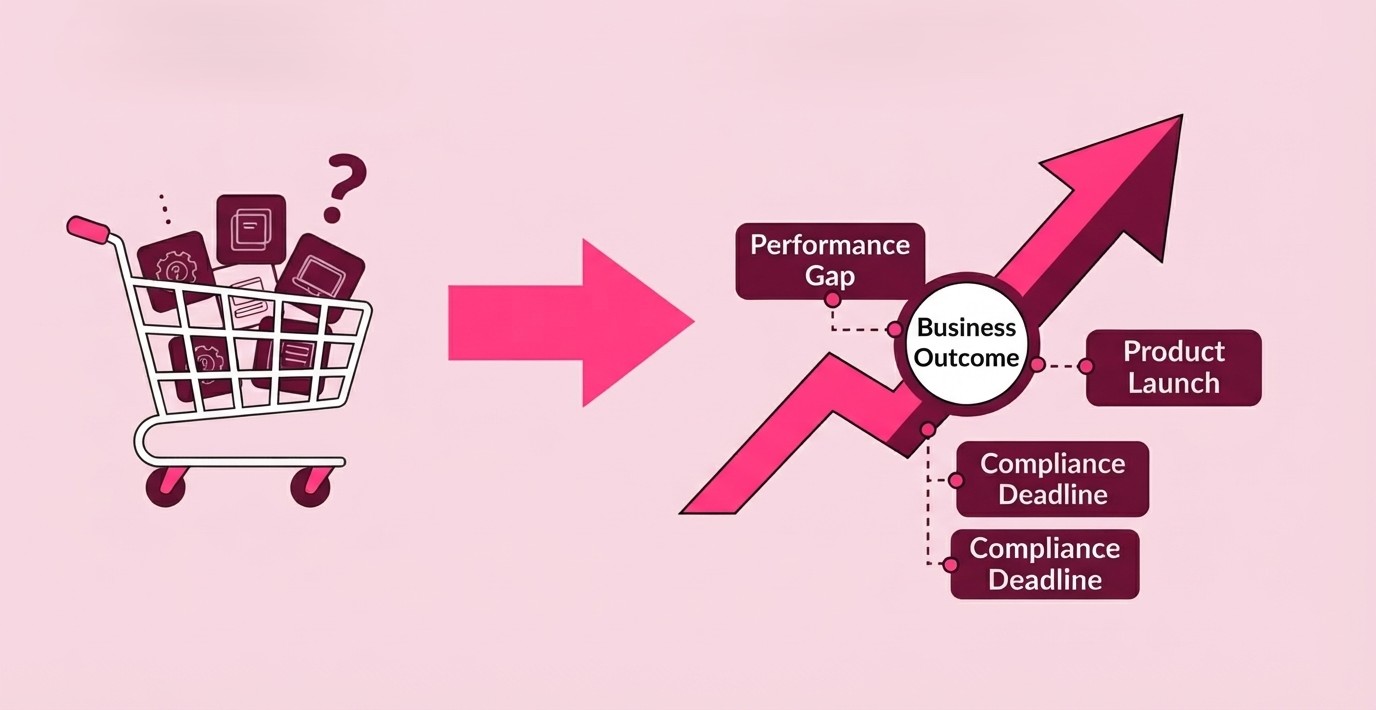
The confusion is understandable, because a course list and a training plan produce the same visible artifact: a spreadsheet, a shared calendar, a set of assignments inside an LMS. The difference is in what sits behind that artifact. A course list gets built from what is available, what a vendor happens to be offering this quarter, what a manager remembers requesting last year, what already exists in a content library. A training plan gets built from what the business actually needs, and the available content is chosen or created to match that need, not the other way around.
That distinction matters most when budgets get tight or time runs short, because a course list has no way to defend itself. If every item on it exists because it seemed useful, there is no basis for deciding what survives a cut and what does not, and everything ends up defended with the same vague justification.
A training plan built around specific business triggers, a new regulatory deadline, a product launch, a persistent gap in a specific team's performance, gives every line an owner and a reason, which makes it possible to say which pieces genuinely cannot be dropped. Published case studies from organizations that have rebuilt their training this way tend to show the same pattern: fewer initiatives running at any one time, but a higher share of them actually completed rather than quietly abandoned partway through the year.
Starting from a needs analysis instead of a wish list
A needs analysis does not have to be an elaborate exercise to be useful. In practice it means asking a short, consistent set of questions before adding anything to the plan: what specific outcome is this meant to change, who is affected by the gap today, what happens if it goes unaddressed for another year, and where is the evidence that the gap actually exists, a performance review, a compliance audit finding, a spike in errors, a manager flagging the same issue across several people.
Requests that cannot answer these questions honestly are not necessarily wrong, but they belong lower on the list than requests that can.
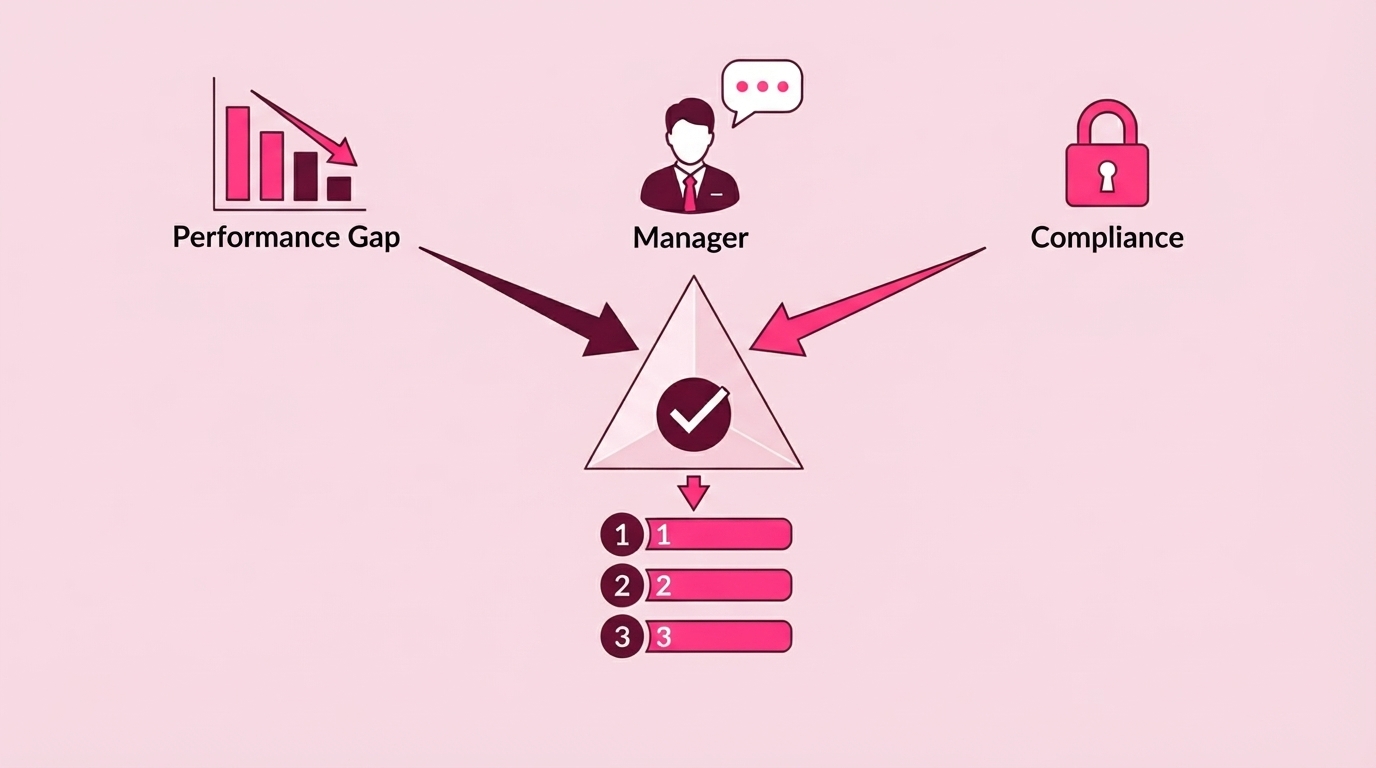
This is also where a training plan starts to separate genuinely different categories of need that often get treated identically: mandatory training tied to a regulation or a certification, which has a hard deadline and little real flexibility, role-specific skill gaps that affect performance but move on a slower and more negotiable timeline, and broader development requests that matter for retention and growth but rarely have a single date attached to them. Folding all three into the same plan without distinguishing between them is exactly how a plan quietly turns back into an undifferentiated course list.
Setting objectives and priorities before choosing any content
The objective is to create a plan where the relative weight of each item is clear before content decisions are made. That means looking at the plan as a whole rather than evaluating requests in isolation. Some initiatives may need immediate action, others may need to be scheduled around a known business change, and some may simply need to remain visible until there is enough capacity to address them. Making those distinctions early prevents content choices from quietly determining the priorities that the plan was supposed to establish in the first place.
Tying every line to a business or role outcome
Every entry in a training plan should be able to complete a single sentence: this training exists so that a specific group can reach a specific outcome, measured by a specific indicator. That sentence forces a decision that a vaguer goal, something like improving leadership skills or increasing engagement, tends to let people avoid. A line that cannot complete that sentence honestly is usually either too broad to plan around yet or does not genuinely need to exist.
This is not a bureaucratic exercise for its own sake. A plan built around outcomes gives everyone downstream, the person building the content, the manager approving time away from work, the person eventually asked whether the training budget was worth it, the same reference point. Without it, three different people can look at the same line on the plan and describe three different reasons it exists, which is usually the moment someone starts asking whether the training function delivers anything measurable at all.

Prioritizing when every request feels urgent
Once a plan includes more than a handful of lines, and most do, prioritization becomes unavoidable, and the instinct to treat every request as equally urgent has to be resisted deliberately. A workable approach ranks each line against two questions rather than one: how severe is the consequence of not delivering it, and how fixed is its deadline. Mandatory compliance training with a regulatory cutoff sits at the top regardless of how it feels to the people building the plan, because the deadline genuinely does not move. A performance gap with no external deadline can still be urgent, but it competes on severity and trend rather than on a fixed date.
The category most training plans handle badly is the large middle ground, that is useful, moderately important, no hard deadline attached. Left unmanaged, this middle ground tends to expand to absorb whatever capacity is left over once the genuinely urgent items are handled, which usually means it gets squeezed into whatever time and budget remain rather than planned deliberately. Setting a rough capacity limit for this category in advance, a fixed number of lines or a fixed share of the total budget, keeps it from either crowding out the rest of the plan or disappearing every year under the weight of more urgent items.
Two fixed-deadline items competing for the same window are the case that breaks most informal prioritization, because both sides can honestly claim their deadline does not move. When that happens, the more useful question is which one has more flexibility somewhere else in its delivery, a longer completion window, a smaller audience, an existing draft that only needs updating rather than building from scratch. Resolving the collision on delivery flexibility rather than on perceived importance avoids the trap of ranking two genuinely mandatory items against each other on a scale that was never designed to compare them.
A simple template for a Corporate Training Plan
None of the above requires specialized software or an elaborate framework to put into practice. A simple table, whether in a spreadsheet or inside whatever system already tracks training assignments, covering the same fields for every line, is usually enough to keep a plan honest. The template below covers the fields that matter most; a plan documented this way already answers most of the questions raised so far.
- Trigger or business reason: the specific event or evidence behind the line, a regulatory deadline, a performance gap, a role change, a new tool or process, rather than a general development goal.
- Target audience: the specific role, team, or group affected, defined narrowly enough that content can be built or chosen for them specifically rather than for everyone by default.
- Priority and deadline type: whether the line is fixed (a hard external deadline), urgent but flexible, or discretionary, so that capacity gets allocated in that order rather than by whoever asked first.
- Success measure: the specific indicator that will show whether the training worked, a completion rate, a reduction in a specific type of error, a passed assessment, rather than attendance alone.
- Content source and format: whether the content already exists in an existing course library, needs to be adapted from an internal document, or has to be built from scratch, and in what format it will actually reach people.
- Delivery window and owner: the period the training needs to be delivered in and who is accountable for it actually happening, distinct from who originally requested it.
The same six fields work whether the plan covers a single department or an entire organization, which is worth knowing before assuming a full plan requires enterprise-level tooling to manage. A team of thirty people can run this structure in a basic spreadsheet with a dozen lines; a company of several thousand across multiple countries typically needs the same fields, just with an additional column for location or business unit, and a review cadence that runs by region rather than as one single annual pass. The structure does not change with scale, only the number of rows and who is responsible for reviewing which subset of them.
Filling in six fields for every line takes longer the first time a plan is built this way than simply listing course names, but it pays for itself the following year. The plan becomes auditable, defensible in a budget conversation, and specific enough that building or sourcing the actual content becomes a much narrower problem than creating training for everyone at once.

Turning the plan into content people actually complete
A carefully built plan still fails at the same point most course lists fail, that is turning each line into something people actually sit through and retain. The traditional route, briefing an external agency or an internal instructional designer for every line, is slow and expensive enough that plans quietly shrink to fit what can realistically be commissioned in the available time, rather than what the needs analysis actually identified. A plan with twenty carefully justified lines often ships with content for six, not because the other fourteen stopped mattering, but because building traditional training for all twenty was never realistic within the year.
Breaking each line of the plan into a short, focused module rather than a long session changes that math directly. A single trigger, a compliance requirement, a tool rollout, a performance gap, rarely needs an hour of content to address, but it needs a specific, narrowly scoped explanation that someone can complete in a few minutes without blocking out half a day. Matching the plan's own structure, one module per line, one clear success measure per module, also makes the plan's own tracking straightforward. Completion against a specific line is a much cleaner signal than attendance at a generic session that was meant to cover several lines at once.
This is also where the practical cost of the plan changes shape. Modern AI-assisted authoring tools can turn a policy document, a procedure guide, or a set of notes from a subject-matter expert directly into a structured module without commissioning outside production for every line, which means the real constraint on how many plan lines get proper content stops being the size of the training budget and starts being how quickly the underlying material can be gathered. For organizations operating across more than one language or location, the same approach extends the plan's reach without adding a parallel production cycle for every market. A module built once can be adapted for each audience rather than commissioned separately for each one.
The advantage carries over into the following year's plan as well, which is usually where a traditionally built plan starts accumulating quiet debt. When a policy changes or a regulation is revised, a module tied directly to that source document can be updated in the time it takes to revise the underlying text, rather than requiring a new production request that competes for the same limited agency or instructional-design capacity as everything else on the plan. Over several review cycles, that difference is often what decides whether a training plan keeps pace with the business or slowly turns back into a list of items nobody has time to refresh.

FAQ
What is the difference between a training plan and a training calendar?
A training calendar lists when existing courses will run. A training plan starts earlier, with the business or role-specific reason for training in the first place, and only later decides on format, timing, and calendar placement. A calendar can exist without a plan behind it; a plan without a calendar is simply unscheduled.
How often should a corporate training plan be updated?
Most plans work best reviewed at least twice a year, not only annually, because business triggers, new regulations, product launches, performance issues, rarely wait for the annual cycle. A lighter quarterly check on priority and deadline status catches items that have become urgent or obsolete without requiring a full rebuild each time.
Who should own the corporate training plan?
Ownership of the plan as a document usually sits with HR or L&D, since they can see requests across every department at once. Ownership of each individual line should sit with whoever requested it or is accountable for the outcome it targets, so that a stalled line has a specific person to follow up with rather than a generic training team.
How many training initiatives should a plan realistically include?
There is no fixed number, but a plan is usually too ambitious if the organization cannot say, for each line, who is actively working on it right now. A shorter plan where every line has real capacity behind it delivers more than a longer one where most items are aspirational placeholders carried over from the previous year.
Does every line on the plan need its own dedicated training content?
Not necessarily. Some lines are best addressed through a policy update, a process change, or a manager conversation rather than a training module, and a plan should allow for that rather than forcing every identified gap into a course. Training is one tool among several for closing a gap, not the default response to every one.


Book a free demo
See how Microlearning365 turns your documents into professional courses in minutes.
.svg)
.svg)
.svg)