
.svg)
Most employers know, in general terms, that safety training is required by law. Far fewer can say with confidence which courses apply to which employee, how many hours each one takes, and when the next renewal falls due, partly because the details change substantially from one country's regulatory framework to the next. That gap matters more than it might seem: incomplete or undocumented training is one of the first things a labour inspector checks after a workplace accident, and it is just as often flagged during routine inspections that have nothing to do with an accident at all.
The shape of the obligation is remarkably consistent across borders. Almost every national safety law requires employers to inform and train workers on the risks of their specific job before they are exposed to it. What differs sharply is how far each country goes in turning that principle into a fixed system of hours, roles, and renewal dates. This guide sets out the common thread that runs through several major regulatory frameworks, and works through the roles and course types that tend to recur.
None of this is limited to large organisations with a dedicated HR department. Owners of small businesses are often the ones most exposed here, since they tend to combine several roles at once, employer, supervisor, and sometimes safety officer, without necessarily realising that each of those roles can carry its own separate training requirement. Whoever in your organisation is responsible for keeping safety training current, from a solo HR generalist to a dedicated HSE function, should be able to use it as a working reference rather than a legal text to decode.
Why safety training is a legal duty
Employer duties in this area tend to trace back to a small number of foundational laws, worded in strikingly similar terms even though they were written decades apart and continents apart.
In the European Union, the 1989 Framework Directive on health and safety at work requires that each worker receive adequate safety and health training, repeated whenever risks change and delivered on the employer's time and at the employer's expense, a principle every member state has since transposed into its own national law, with Italy's Legislative Decree 81/2008 among the more detailed implementations.
In the United Kingdom, the Health and Safety at Work etc. Act 1974 imposes a parallel duty to provide information, instruction, training, and supervision so far as reasonably practicable, later given more operational detail by the Management of Health and Safety at Work Regulations 1999. In the United States, the Occupational Safety and Health Act's General Duty Clause does not mention training directly, requiring instead a workplace free from recognised hazards, with the actual training obligations arriving through hazard-specific standards issued under the same Act.
What these frameworks share is the underlying logic: inform and train workers about the risks of their specific job before they are exposed to it, and keep doing so as those risks change. What they do not share is how prescriptive they get about turning that logic into a number of hours. Some systems, Italy's among the clearest examples, fix precise hours and renewal cycles for a defined list of roles through a national accord. Others, the UK's among them, leave the employer to judge what training is adequate for a given role, backed up by recognised qualifications rather than a statutory hour count. The United States sits somewhere in between: no general hour requirement at all, but very specific hour tiers for particular hazards, the 40, 24, and 8-hour tiers of hazardous waste operations training being a widely used example.
In most of these systems, the duty to ensure training happened sits with the employer personally, and cannot be discharged simply by hiring someone else to manage it.
Appointing a safety officer or an external consultant does not transfer legal responsibility if training turns out to be missing or incomplete. In a workplace accident investigation, one of the first documents an inspector requests, wherever the investigation is taking place, is the training record, showing who was trained, on what, for how long, and by whom. Gaps in that record can turn an accident into a liability case for the employer or a delegated manager, on top of whatever administrative penalties apply regardless of whether an accident has occurred.
The exact penalty regime, and what triggers an inspection in the first place, varies by country and often by sector within the same country. What tends to hold everywhere is the direction of the arithmetic: the cost of skipping or postponing mandatory training is consistently smaller than the cost of the course itself once fines, potential suspension of an activity, and reputational damage after an inspection are added up. Regulatory frameworks in this area also tend to be revised periodically, Italy's underwent a significant overhaul as recently as 2025, so a training plan that was compliant a few years ago is worth re-checking against current requirements rather than assumed to still be correct.
Completing a course is rarely treated, on its own, as proof that training happened.
Many frameworks, Italy's Legislative Decree 81/2008 among them, expect some form of final verification, a short test, a practical demonstration, or a structured interview, confirming that participants actually absorbed the content rather than simply attending. Attendance sheets and certificates remain necessary, but an inspector reviewing a file after an accident will also look for evidence that comprehension was checked, particularly for workers who are not fully fluent in the language the course was delivered in.
The obligation also tends to extend beyond a company's own payroll. The EU Framework Directive itself requires employers to ensure workers from external organisations receive appropriate safety instructions for the site, and Italy's implementation goes further still: under Article 26 of Legislative Decree 81/2008, a business that brings in contractors, subcontractors, or self-employed workers has a duty to verify that those external workers have received training appropriate to the risks of the site, and to coordinate on any additional risks that arise specifically from having two organisations working in the same space at the same time. In practice, this means a client company cannot simply assume a contractor's own paperwork is in order: verifying it, and documenting that verification, is part of the client's own compliance obligation, not a courtesy extended to the contractor.

Who has to be trained, and for what
Employees, based on their exposure to risk
Nearly every framework in this area starts from the same split: a short, universal module covering shared ground, workers' rights and duties, how the company's safety model works, how to report a hazard or a near miss, and a second, longer module tied to the actual risks of a person's specific job. In Italy, for instance, that universal module runs for a fixed 4 hours regardless of sector, while the job-specific module scales with risk. Other systems reach a similar split without fixing a headline number: UK guidance under the Management of Health and Safety at Work Regulations simply requires training proportionate to the risk identified in the employer's own risk assessment, leaving the exact duration to that assessment rather than to a national table.
How that job-specific training scales is itself a point of real difference between systems. Italy ties it to the risk classification of the employer's own economic activity, determined by an official sector code rather than an internal assessment, placing every company into a low, medium, or high risk band with a corresponding number of hours. A retail or office-based business typically falls into the low band, logistics and manufacturing often sit in the medium band, and construction, chemical, or healthcare-adjacent activities are frequently classified as high risk. The United States takes a different route entirely: rather than a general risk-tier system, specific hazards each carry their own training standard, so a business is more likely to be checking a list of applicable OSHA standards for its particular operations than a single risk classification table.
Two relatively recent Italian changes are worth flagging as an illustration of how quickly these details can move, even within a single country's system. A 2025 reform brought forward the point at which general and job-specific training must be completed, now required before an employee starts working rather than within an initial grace period as previously allowed, and tightened the requirement to verify that workers who are not fluent in the course's language have actually understood the content, rather than treating attendance alone as sufficient. Neither change is a universal pattern elsewhere, but both are a useful reminder that whichever country's rules apply to your business, it is worth checking whether the guidance you are relying on predates the most recent revision.
Employment status adds another layer that recurs across most systems in some form. Workers supplied through a staffing agency are typically trained under a shared responsibility: the agency covers the universal module, while the company that actually hosts them day to day is responsible for training tied to the tasks and equipment the worker will encounter on-site. Seasonal and short-term staff are rarely exempt simply because their contract is brief, which means a business with a strongly seasonal headcount needs a training pipeline that can turn new joiners around quickly. Remote and hybrid employees, meanwhile, still require training that reflects their actual working conditions, including the equipment and environment of a home workspace, even though the traditional image of workplace risk assumes a shared physical site.
Managers, employers, and specialist safety roles
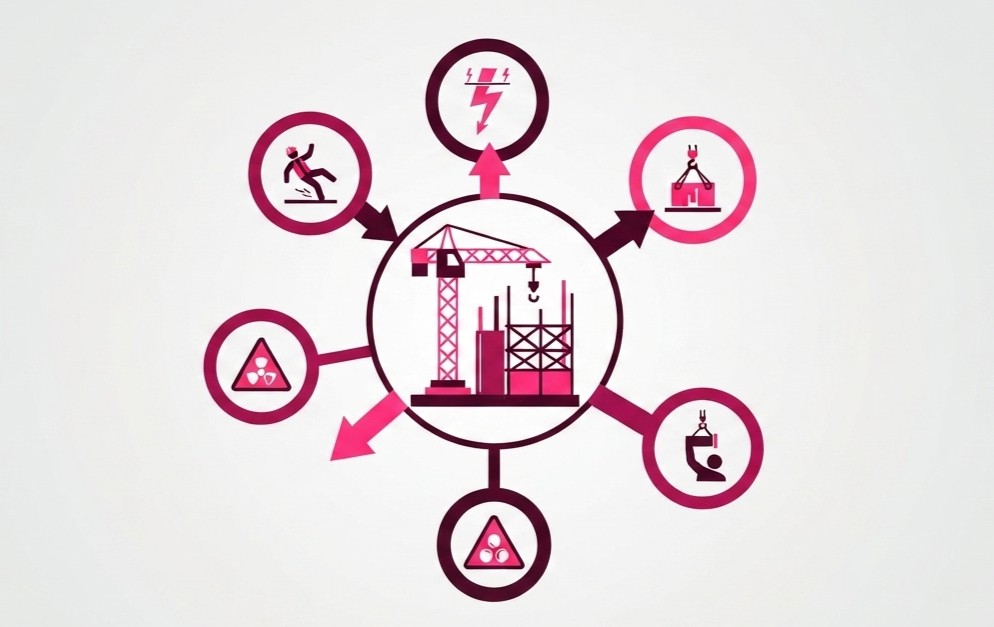
Beyond general staff, most frameworks recognise a small set of roles that carry extra responsibility for other people's safety, and give each one its own training track: someone who supervises day-to-day work, someone with delegated management responsibility, the employer personally, and a worker-elected safety representative. The EU Framework Directive itself entitles workers' representatives with a safety role to appropriate training, a requirement every member state has had to implement in its own way. Italy's version, the workers' safety representative or RLS, is one of the more developed examples: 32 hours of initial training regardless of company size, followed by an annual refresher of 4 to 8 hours depending on headcount, with a 2025 measure extending the obligation to smaller companies that previously fell below the threshold and permitting the annual refresher to run through e-learning for the first time.
Italy's 2025 reform illustrates how granular this can get. The supervisor course grew from 8 to 12 hours with renewal tightened from five years to two, delivery restricted to a classroom or live videoconference rather than self-paced e-learning, and its content shifted to lean more heavily on conflict management and communication, reflecting the practical reality that a supervisor is expected to intervene in real time rather than just file a report afterwards. The manager course moved the other way, reduced from 16 to 12 hours with a further 6-hour module for construction-site duties, while employers themselves gained an entirely new obligation: even an employer who does not act as their own designated safety officer must now complete 16 hours of training. A system like the UK's reaches a broadly similar allocation of responsibility, supervisors, managers, and employers each expected to be competent for their role, without translating it into a comparable table of hours: the test is whether the training given was adequate for what reasonably practicable safety required, judged after the fact if it is ever challenged.
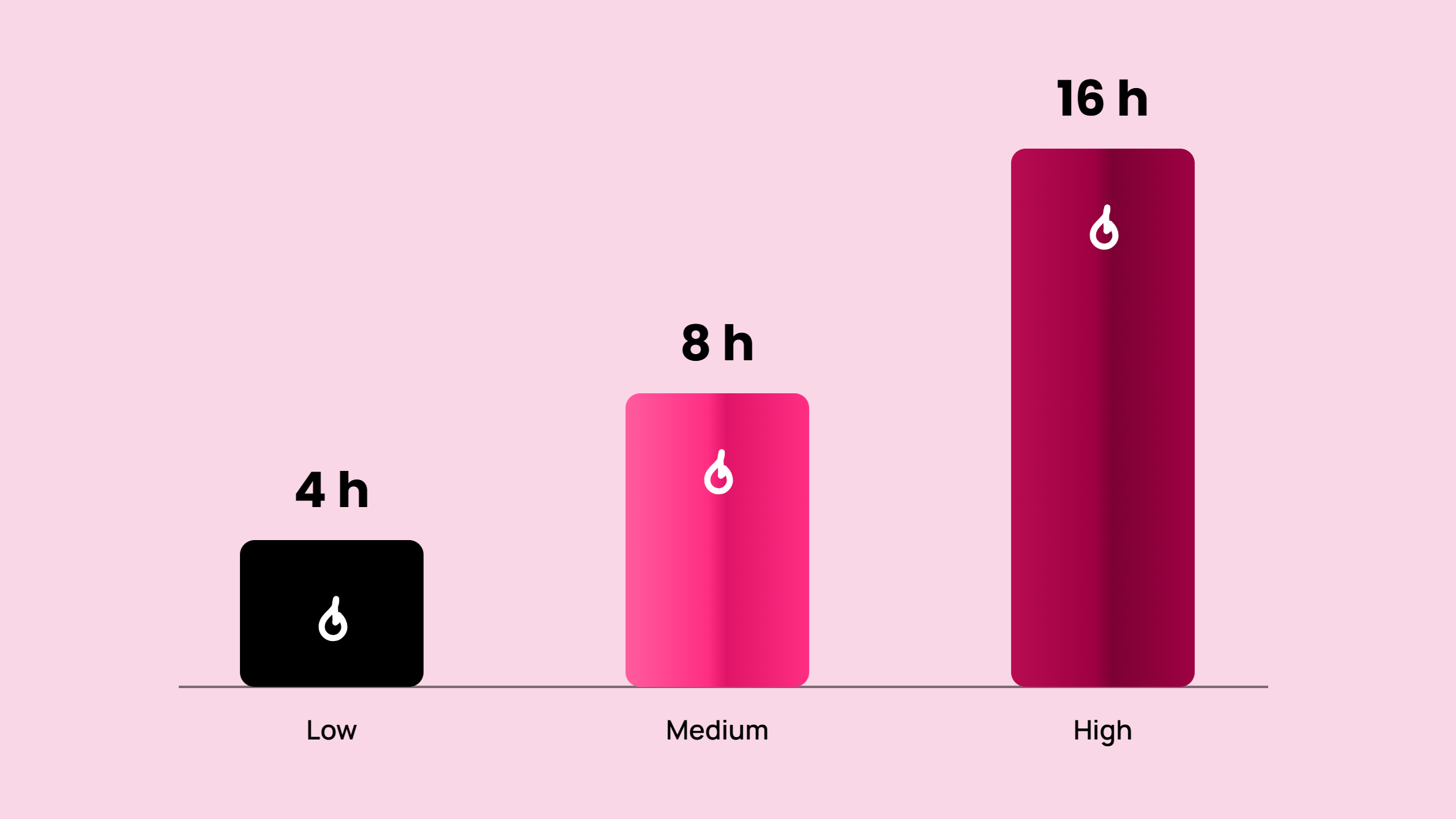
Specialist appointments for fire safety and first aid follow a similar split between hour-based and adequacy-based systems. Italy sets out three fire safety tiers tied to the fire risk of the premises, four hours for the lowest, eight for the medium tier, sixteen for the highest, each with its own shorter refresher cycle, and two first aid categories tied to the company's overall risk profile. The UK reaches a similar outcome through recognised qualifications rather than statute: Emergency First Aid at Work, a six-hour course valid for three years, and the fuller three-day First Aid at Work qualification, are HSE-recognised routes to satisfying a general duty to have enough trained first-aiders, without the underlying duty itself specifying those hours. The United States applies its fire extinguisher and first aid training standards only under certain conditions, when employees are expected to use an extinguisher, or when no medical facility is close by, again without mandating a fixed number of hours. Whichever regime applies, both appointments typically include a hands-on practical component that no format, in any country, treats as deliverable through self-paced e-learning alone.
Group size for the practical component is often capped by regulation rather than left to the training provider's discretion. Italy, for instance, limits practical sessions, extinguisher handling, evacuation drills, resuscitation manoeuvres, to a small number of participants per trainer even where the theory session can take a larger group. A company with a large workforce concentrated on a single site should expect to run several parallel practical sessions rather than a single company-wide event, a planning consideration that holds regardless of which country's specific rules apply.
Mandatory Safety Training Courses: what to expect on hours and renewal
By this point in the article, a pattern should be clear: some regulatory systems answer the question of how many hours a course should run with a specific number for each role, and others answer it with a standard of adequacy that the employer has to satisfy and be ready to defend if challenged. Neither model is more rigorous than the other in principle, an adequacy-based system can in theory demand more training than a prescriptive one for a genuinely high-risk role, but they are very different to plan around, and mixing up which model applies to your business is one of the more common ways compliance quietly slips.
Where hours are fixed, as in Italy, duration and renewal frequency scale along two variables: how much risk a role is exposed to, and how much responsibility that role carries for other people's safety. General training is deliberately short because it covers shared ground; job-specific training grows in stages as the underlying activity moves from lower to higher risk; supervisory, management, and employer courses run longer again and renew more often, on cycles running from two to five years depending on the role; and the safety representative and specialist appointees sit on their own, separate clocks entirely.
Where the model is adequacy-based, as in the UK, the practical question shifts from how many hours a role requires to what evidence would show a regulator, after the fact, that the training given was proportionate to the risk. That tends to push businesses toward recognised third-party qualifications, which at least establish a defensible baseline, even though nothing in the underlying law requires that specific course. The US arrangement is narrower still: no general training obligation to plan around at all, only a checklist of hazard-specific standards, each with its own trigger condition and, where one applies, sometimes a fixed hour count of its own.
Choosing the right format and planning ahead
Because the details in an hour-fixed system are tied to national accords or decrees that get revised periodically, and because the exact classification of a role or activity can shift the numbers involved, this article deliberately describes the shape of these systems rather than a fixed figure for every possible combination of role, sector, and country.
A training provider or safety consultant licensed in the relevant jurisdiction can confirm the precise requirement that applies to a specific company once its activity, size, and location are known. Delivery format is worth confirming at the same time as duration: Italy, for example, now requires supervisor training to run in a classroom or live videoconference rather than self-paced e-learning, while general staff, manager, and employer training in the same system can generally run online provided the platform meets interactivity and tracking standards, a distinction that would not necessarily carry over to a business operating under a different country's rules.
Companies operating across more than one location add a further wrinkle, and not only within a single country: risk classification, in the systems that use it, is tied to the activity actually carried out at a given site rather than to the company as a single, uniform entity, and a business with operations in more than one country is, in effect, running more than one compliance system at once. A head office and a warehouse can reasonably owe their staff different training paths even under one country's rules; a head office in one country and a production site in another are answering to two different frameworks entirely. Treating every site, and every jurisdiction, as its own compliance unit, with its own classification, its own course mix, and its own renewal calendar, tends to catch these differences earlier than managing the business as a single undifferentiated headcount.

Keeping mandatory training under control without a full-time administrative team
On paper, none of this is complicated. In practice, a company with a few dozen employees can easily be tracking a dozen different course types, each with its own renewal date, its own permitted delivery format, its own documentation requirements, and, for any business operating across borders, its own applicable jurisdiction. New hires need their required training completed before their first working day, not scheduled for whenever the next course happens to run. Seasonal and temporary staff compress the same obligations into a much shorter window. A change in a role, a change in how an activity is classified, or a move into a new country's operations, can quietly shift what an entire team is required to complete.
The starting point, in almost every system, is a single, complete training record per employee: course type, date, duration, trainer's qualifications, and proof of attendance or completion.
How long that record must be kept varies by country, Italy requires at least ten years, other jurisdictions set shorter or longer periods, so this is worth confirming locally rather than assuming one figure travels everywhere. Treating the record as a live document tied to individual expiry dates, rather than a single company-wide renewal date, avoids the common failure mode where one department is compliant while another has quietly lapsed. It is also worth keeping an explicit, role-by-role note of which courses your company delivers through e-learning and which require classroom or live-videoconference attendance, since that boundary is one of the more common points of difference between jurisdictions and can shift within a single country's own rules over time.
It is worth running an internal check on this material before an external inspector ever does.
A short periodic review, comparing the current headcount and role list against the training record, tends to surface the same handful of gaps every time: a new hire who started before their job-specific training was booked, a supervisor whose renewal clock quietly rolled over during a busy quarter, a contractor whose credentials were taken at face value rather than verified. Catching these internally, on a schedule the company controls, is a very different experience from having them surface for the first time during an inspection that was triggered by something else entirely.
Where digital tools fit in
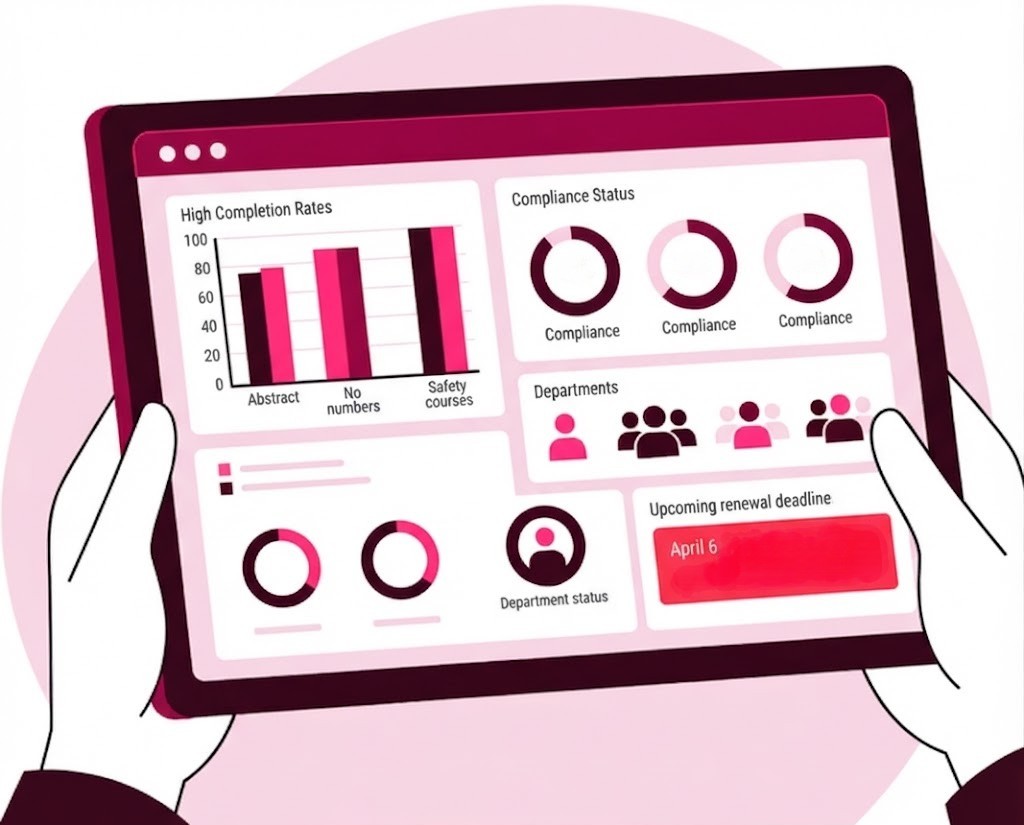
This is also where a digital training platform earns its keep, less as a way to make any single course faster and more as a way to remove the coordination burden entirely. A system that assigns the right course to the right role and jurisdiction automatically, tracks completion and expiry per employee, and flags upcoming renewals before they lapse turns a spreadsheet-and-reminder exercise into something the HR or HSE team can monitor in a few minutes a week, leaving their actual time for the classroom and practical sessions that, as this guide has shown, cannot be replaced by any software regardless of which country's rules apply.
The same system can usefully hold the parts of the picture that have nothing to do with hours or renewal dates: which language each employee needs their materials in, whether their comprehension was verified and how, which site, risk classification, and regulatory framework they currently sit under, and whether they arrived through direct hire, a staffing agency, or a contractor relationship. None of that is required to live in a single tool, but scattering it across separate spreadsheets, email threads, and paper files is exactly how the small, individually minor gaps described above end up compounding into the kind of pattern an inspector notices immediately.
FAQ
What happens if a company does not provide mandatory safety training?
Consequences vary by country, but the pattern is consistent: the employer, and often any manager with delegated safety duties, can face administrative fines and, in more serious cases, criminal liability, particularly if an accident occurs and the training record shows gaps. Regulators in several systems, Italy among them, can also order the suspension of specific activities until the missing training is completed and documented.
How often must safety training be renewed?
It depends on both the role and the country. In hour-fixed systems like Italy's, general and job-specific training typically renews every 5 years, supervisors every 2 years, the safety representative annually, and fire safety or first aid certificates every 3 to 5 years. In adequacy-based systems, renewal is tied to the employer's own judgement of when a risk assessment or a role has changed enough to require it again.
Can workplace safety training be delivered online?
In many systems, general staff training, manager training, and employer training can run through e-learning provided the platform meets recognised interactivity and tracking standards. Supervisor training is a common exception, Italy now requires it in a classroom or live videoconference, and the practical component of fire safety and first aid courses almost universally requires physical attendance regardless of jurisdiction.
Who decides whether a job is low, medium, or high risk?
In systems that use a formal risk-tier structure, like Italy's, the classification follows the official activity code assigned to the employer's economic activity, not an internal judgement. In adequacy-based systems, the equivalent exercise is the employer's own risk assessment, which then has to be defensible if challenged rather than checked against a national table.
Does the safety representative need separate training from other employees?
Generally yes. A worker-elected safety representative is a role recognised across most European frameworks, entitled to its own training separate from general staff training. Italy's version follows a dedicated track of 32 hours of initial training plus an annual refresher; the exact structure elsewhere depends on how each country has implemented the underlying principle.
Are contractors and subcontractors covered by the same training rules?
Contractors and subcontractors are trained by their own employer, but the client company hosting them on-site typically has a separate duty, recognised in the EU Framework Directive and made explicit in Italy's implementing law, to verify that this training actually happened and to coordinate on risks that arise from having two organisations working in the same space. Taking a contractor's paperwork at face value, without checking it, does not usually satisfy that duty.
Do fire safety and first aid training count toward the same renewal cycle as other courses?
Rarely. In most systems these appointments are governed by separate rules from general staff, supervisor, manager, and employer training, so they run on their own renewal clocks and are not satisfied by completing any of the other mandatory courses described in this guide, even where the content overlaps in places.


Book a free demo
See how Microlearning365 turns your documents into professional courses in minutes.


.svg)