
.svg)
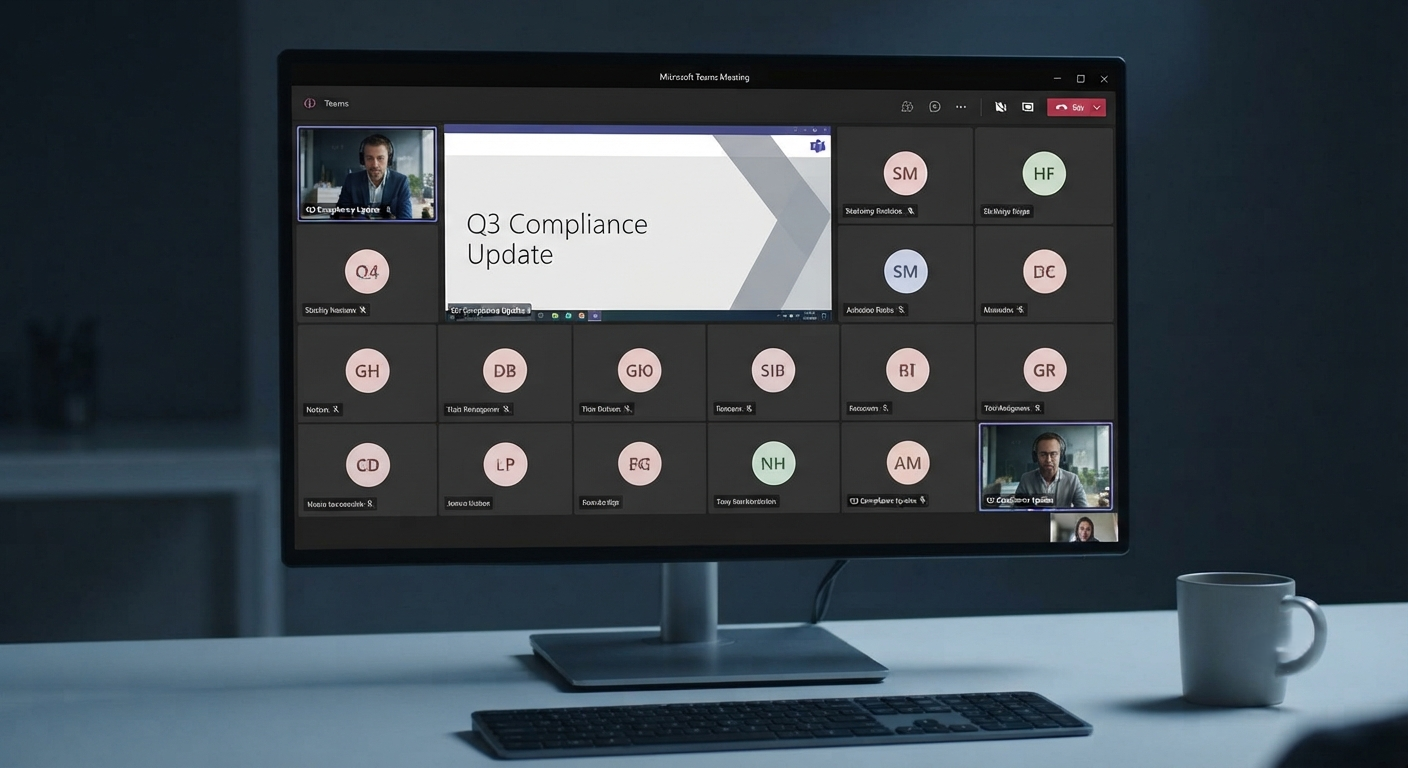
A training meeting on Microsoft Teams where most cameras are turned off is the signal that asynchronous corporate training would have been far more effective. People participate formally, but real attention is elsewhere, and the session content is almost entirely lost.
In this article we look at the real cost of an ineffective training meeting, why asynchronous corporate training resolves the problem at its root, when the asynchronous format genuinely works, and how to manage the transition to a different training model without meeting significant resistance.
The cameras-off problem is not a failure of individual motivation. It is a signal that the format is wrong. Understanding why that format fails, and what replaces it effectively, is the starting point for any organisation that wants training to produce real behaviour change rather than just compliance on paper.
The Problem With Synchronous Training: Why Asynchronous Corporate Training Works Better
When a one-hour training meeting has cameras off and little interaction, the problem is rarely a connection issue or individual fatigue. It is a signal that the long, synchronous session format does not fit the way people actually learn in a work context.
Research by Professor Gloria Mark of the University of California, Irvine, frequently cited in discussions on asynchronous corporate training, shows that the average sustained concentration time on a single screen has fallen to approximately 47 seconds in the most recent measurements. A one-hour meeting requires sustained concentration far beyond this threshold. The result is that most participants interrupt their active attention multiple times during the session, often without the facilitator noticing.
The problem is compounded by the cameras-off dynamic.
A participant checking email or responding to messages in parallel is not following the session: they are pretending to. Synchronous training, in that context, becomes a presence ritual that produces no learning. The organisation records the attendance, the employee stays connected for an hour, and by the following week the content is gone.
This is not a new phenomenon. A one-hour synchronous session presents a large volume of information in a compressed timeframe, which is precisely the condition under which the forgetting curve works fastest. The format is structurally at odds with how adult memory consolidates information.
The Real Cost of an Ineffective Training Meeting
The cost of a training meeting is the sum of elements that are rarely calculated together.
- The time of all participants: A one-hour meeting with 30 people costs 30 hours of organisational productivity. If the meeting is repeated four times a year on the same topic because the training content is not retained, that cost multiplies by four. At an average hourly cost of €25 per employee, 30 people for one hour means €750 in direct cost per session alone. If the topic requires four sessions per year, the direct people cost is €3,000 before any production or facilitation costs are counted.
- The coordination cost: Finding a time when 30 or 50 people are simultaneously available takes weeks of calendar management, especially in organisations with teams distributed across time zones or operational staff working shifts. This coordination work is invisible in most training budgets, but it is real and recurring.
- The low-retention cost: Most content learned in a long session is forgotten within 24-48 hours without reinforcement. This means the meeting does not produce the expected effect, and the same topic often has to be covered again in subsequent months, multiplying the overall cost. The meeting creates the appearance of training without delivering the substance.
- The traceability cost: For a quality team facing an ISO audit, an ineffective meeting creates the risk of being unable to demonstrate that staff actually understood the procedures, not just that they attended a call. An asynchronous module with integrated quizzes produces a verifiable data point for every individual, linking each person to a specific score and completion date.
Adding these costs together, a single one-hour training meeting for 50 people, repeated quarterly on a topic that requires annual reinforcement, can easily represent €15,000-20,000 in combined people costs per year, for a single topic. Most organisations run dozens of such sessions. The aggregate cost is rarely visible because the individual components are never calculated together.
Asynchronous Training: Definition and Difference From Synchronous Training
Asynchronous corporate training is training that employees can follow independently, at the time and place they prefer, without needing to be present simultaneously with the facilitator or colleagues. On-demand micro-courses, eLearning modules with integrated quizzes, and learning nuggets distributed via an LMS are all asynchronous formats.
Synchronous training is training that happens in real time, in classroom sessions, live webinars, Teams sessions with a facilitator. Neither approach is categorically superior, it depends on the learning objective.
Asynchronous corporate training works best for procedural, regulatory and continuous update content, where the objective is to transfer clear, verifiable information with a quiz. Synchronous training remains irreplaceable for real-time discussion, peer exchange on a specific problem, individual coaching or collaborative case resolution.
The distinction matters because many organisations apply the synchronous format to content that has no need for real-time interaction. A mandatory data protection update does not benefit from being delivered as a live webinar. A new onboarding procedure does not need a facilitated session. These are information-transfer tasks, and information transfer is exactly where asynchronous corporate training outperforms the synchronous alternative on every measurable dimension: retention, traceability, scalability and cost.
The Advantages of Asynchronous Learning at Work
Adopting asynchronous corporate training produces benefits that go well beyond time savings.
- Flexible access: Asynchronous corporate training allows every person to follow content when they are genuinely available and focused, rather than attending at a fixed time regardless of workload. For teams with different shifts, distributed time zones or variable daily workloads, this flexibility is not an optional extra: it is the only format compatible with their operational reality. A logistics company with drivers across multiple time zones cannot synchronise everyone for a live session. An asynchronous module reaches everyone, simultaneously, without scheduling.
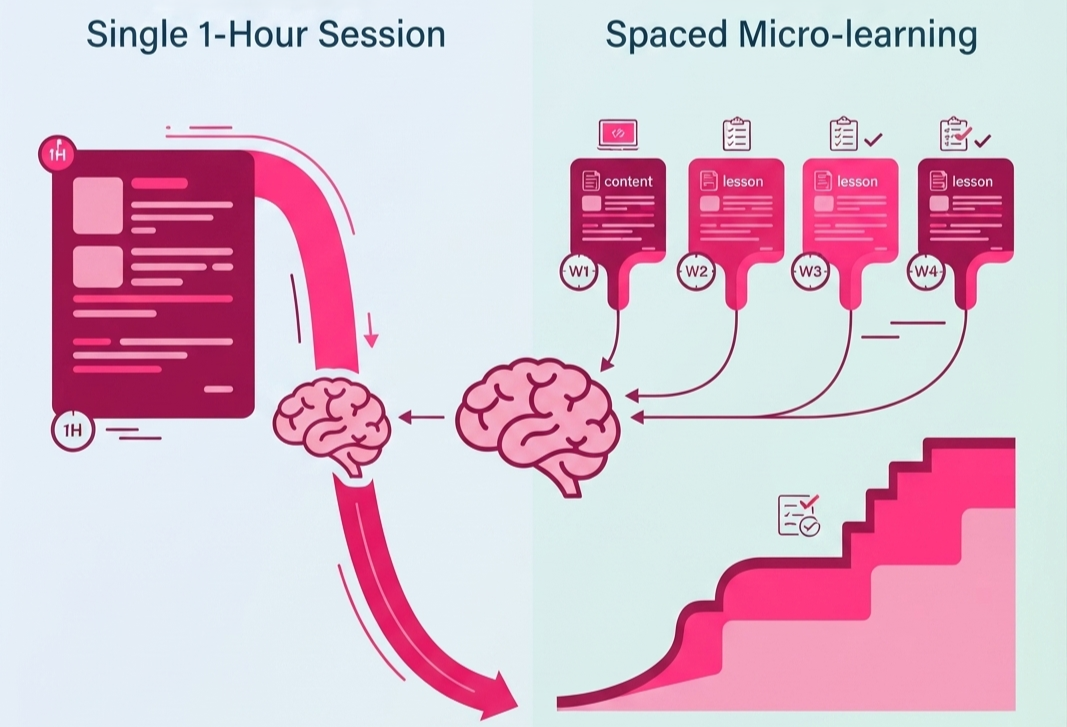
- Higher retention: Short modules distributed over time, with integrated verification quizzes, produce significantly higher retention than a single long session. This is the mechanism known as spaced repetition: presenting information in brief, separated exposures rather than a single concentrated block. The research supporting spaced repetition as a memory consolidation technique is extensive and consistent. The practical implication is that a series of five-minute modules over four weeks will produce better retention than a single two-hour session covering the same material.
- Granular traceability: A well-designed asynchronous corporate training system produces verifiable data for every employee: who completed what, when, and with what score. This data is invaluable for compliance audits and for identifying training gaps by department or role. A quality manager preparing for an ISO audit can generate a completion report in minutes. An HR director monitoring onboarding effectiveness can see exactly which modules are creating friction for new hires.
- Immediate scalability: Asynchronous corporate training updates instantly: modifying a module when a procedure changes takes minutes. The new version is available to everyone simultaneously, without organising new sessions, re-booking facilitators or coordinating calendars. For organisations that operate in regulated environments where procedures change frequently, this scalability is a significant operational advantage.
- Fewer meetings on the calendar: Replacing training meetings with asynchronous modules frees up calendar slots for discussions that genuinely require simultaneous presence. Over time, this has a measurable effect on meeting culture: the sessions that remain are the ones that actually need real-time interaction, which tends to improve their quality and engagement.
When to Use Synchronous and When to Use Asynchronous Training
The most effective approach is not to eliminate synchronous formats, but to understand which format serves which objective. Both have a legitimate role; the problem is using them interchangeably.
Use asynchronous training for:
- standard operating procedures,
- company policies,
- mandatory compliance training (health and safety, GDPR, ISO, NIS2),
- initial onboarding content,
- product or regulatory updates,
- training for geographically distributed or operational staff,
- any content where the primary goal is information transfer and verifiable understanding.
Keep synchronous training for:
- workshops and collaborative problem solving,
- individual coaching and performance conversations,
- discussions on specific cases requiring direct exchange,
- crisis response or urgent organisational changes,
- any situation where the value comes specifically from people thinking together in real time.
A practical heuristic: if a training session could theoretically be replaced by a well-written document, it can almost certainly be replaced by an asynchronous module. If removing the live interaction would fundamentally change what participants get out of it, the synchronous format is warranted.
How to Create Asynchronous Micro-Courses From Existing Documents
One of the historical barriers to asynchronous corporate training was the production cost. Creating a quality eLearning module traditionally required instructional design expertise, dedicated authoring software, graphic design, voiceover recording and review cycles that stretched over weeks. The cost per module with an external agency typically ranged from €3,000 to €5,000.
AI authoring has changed this. With a modern AI-powered authoring tool, the process is:
- Upload the source document: the procedure, policy or manual already in use within the organisation.
- The AI generates the course: structures the lessons, creates the verification quizzes, produces the voiceover.
- Review and publish: the HR team verifies the content, makes any necessary adjustments and publishes directly to Teams.
Total time for a module of 5-7 lessons: 3-5 minutes of AI generation, plus review time. No instructional design skills are required, no separate production tools are needed. Any existing company document can become an asynchronous course. The procedure manual that has sat in a SharePoint folder for three years, unread by most of the team, can become a structured learning experience in an afternoon.
This change in production economics has a direct effect on how organisations can approach training strategy. When each course costs €3,000-5,000 and takes three weeks to produce, training must be rationed: only the most critical topics get covered, updates are delayed, and new hires receive fewer resources than they need.
When course creation takes minutes and costs nothing extra per module, training can be comprehensive, timely and continuously maintained.
Managing the Transition: Practical Change Management
Introducing asynchronous corporate training gradually, starting with topics that naturally suit the format, and sharing completion data after the first cycle significantly reduces resistance.
Resistance typically comes from two directions. Facilitators worry about losing control over the learning experience and the ability to answer questions in real time. Employees, accustomed to passively attending a call, can perceive an asynchronous module as additional work rather than a time saving. Both concerns are addressable, but they require different responses.
For facilitators: the asynchronous module does not replace their expertise, it repackages it into a format that reaches more people more effectively. The questions that emerge from quizzes and module comments become the agenda for short, targeted live sessions rather than long, unfocused meetings. The facilitator role evolves from presenter to curator and coach.
For employees: starting with a topic they find genuinely useful, and delivering the module through Teams rather than asking them to log into an unfamiliar platform, removes most of the practical resistance. The first experience sets the expectation. If the first asynchronous module is well-designed, relevant and takes less than five minutes, the transition is largely won.
A practical starting point is to identify one or two topics naturally suited to the asynchronous format, such as a safety policy or a standard operating procedure, and run a pilot with those while keeping the synchronous meeting for topics that require discussion.
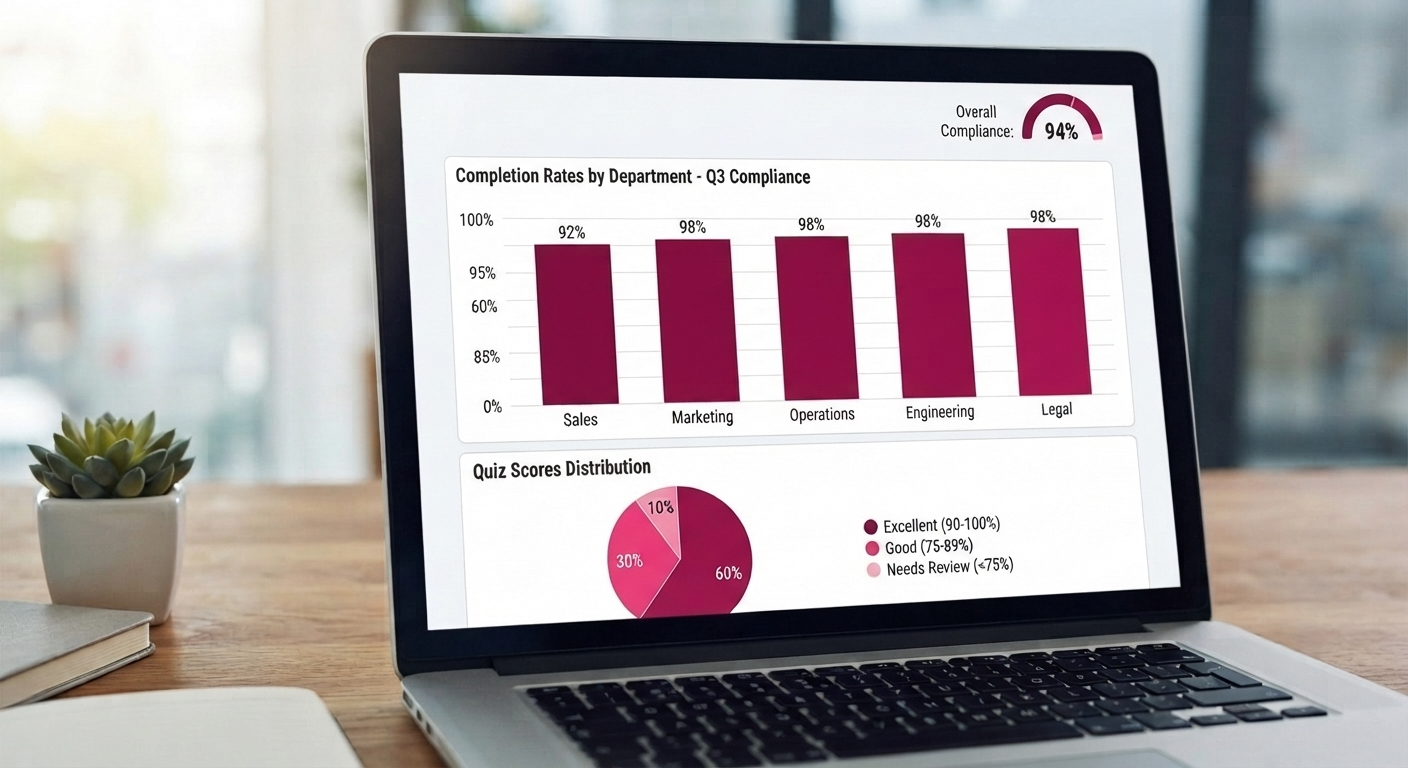
The completion rate of a well-designed asynchronous module distributed via Teams tends to be higher than that of a training meeting, because it does not require simultaneous attendance and can be completed during quieter moments.
Sharing this data with the team after the first cycle reduces resistance to change far more effectively than any theoretical argument.
Training Meeting vs Asynchronous Micro-Course
FAQ
Is asynchronous learning less effective than a live meeting?
No. For procedural and regulatory content, research consistently shows that retention is better with short modules distributed over time than with a single long session. This is because spaced repetition aligns with how the brain consolidates new information. Live meetings remain more appropriate for discussion, direct peer exchange, coaching and situations where the interaction itself is the learning.
How is the effectiveness of an asynchronous training programme measured?
The main metrics are module completion rate, quiz scores, time to completion (which indicates whether employees are engaging seriously or skipping through), and where possible, observable changes in behaviour or performance. An LMS produces all of these automatically. The difference between those who completed with a high score and those with a low score is directly actionable: targeted follow-up can address the gap.
How is resistance to the shift towards asynchronous training managed?
By introducing the change gradually, starting with topics that naturally suit the asynchronous format, and sharing completion data after the first cycle. Numbers tend to reduce resistance more effectively than theoretical arguments. When the team sees that the asynchronous pilot produced a higher completion rate than the last live session on the same topic, the conversation changes.
Is asynchronous microlearning suitable for regulated sectors such as pharmaceuticals?
Yes, provided the system tracks completion and quiz results in a demonstrable, exportable way. In regulated sectors, the traceability requirement is explicit: auditors want to see who completed what, when, and with what score. A well-configured LMS satisfies this requirement more reliably than an attendance register from a live session.
Why does a long meeting lose effectiveness even when participants stay connected?
Because staying connected is not the same as paying attention. Research indicates that the average time before an attention break during screen-based work is approximately 47 seconds. Over the course of an hour-long session, most participants will have had dozens of attention breaks, each pulling cognitive resources away from the content. The meeting records their presence; it cannot record their attention.


Book a free demo
See how Microlearning365 turns your documents into professional courses in minutes.

.svg)
.svg)